If you are using a visual representation/image children are intended to relate to, then it is important to choose one that is meaningful and indicates/supports the structure of the intended mathematics.
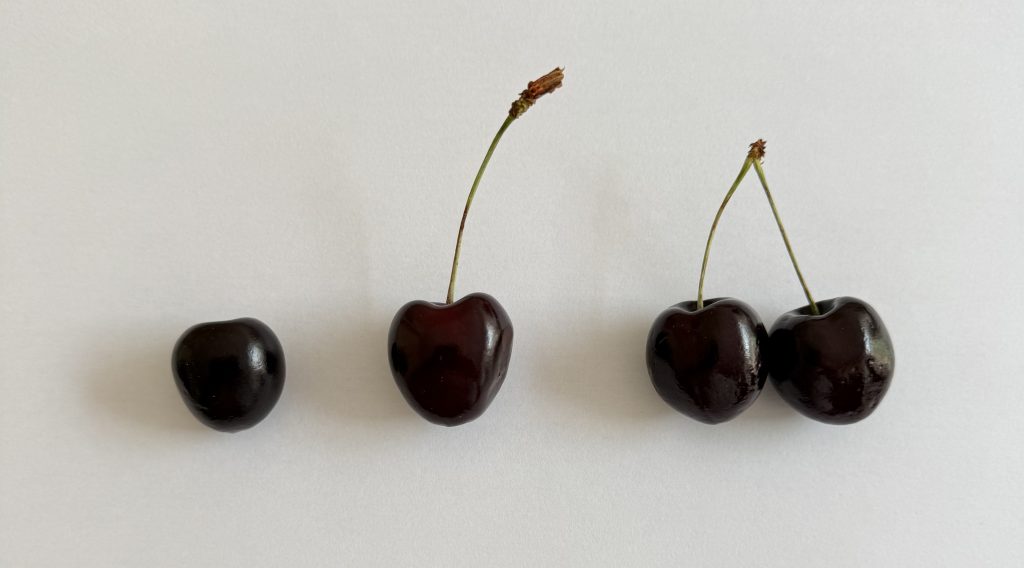
In the real world children generally see cherries as individual fruits in a carton/punnet, sometimes on a stem, and very occasionally as a pair of fruits on stems linked to the focal point/spur.
I have yet to see in any punnet of cherries 3 cherries stems linked to the focal point spur (not even in M&S 😁). Maybe because research from fruit growers, suggests pruning by farmers due to under development of a 3rd fruit is prevalent, therefore the concept of a triple is not going to be in the child’s experience and mind.
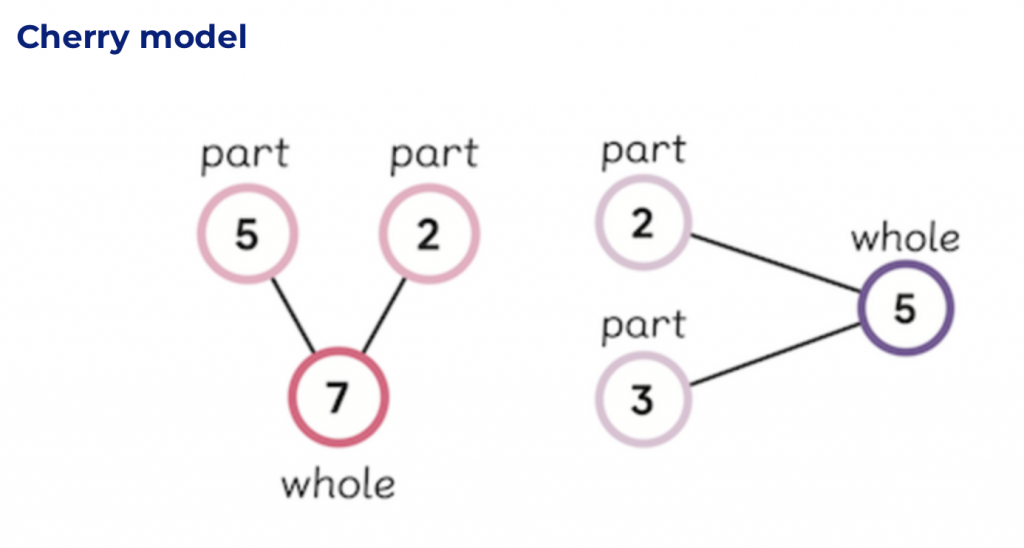
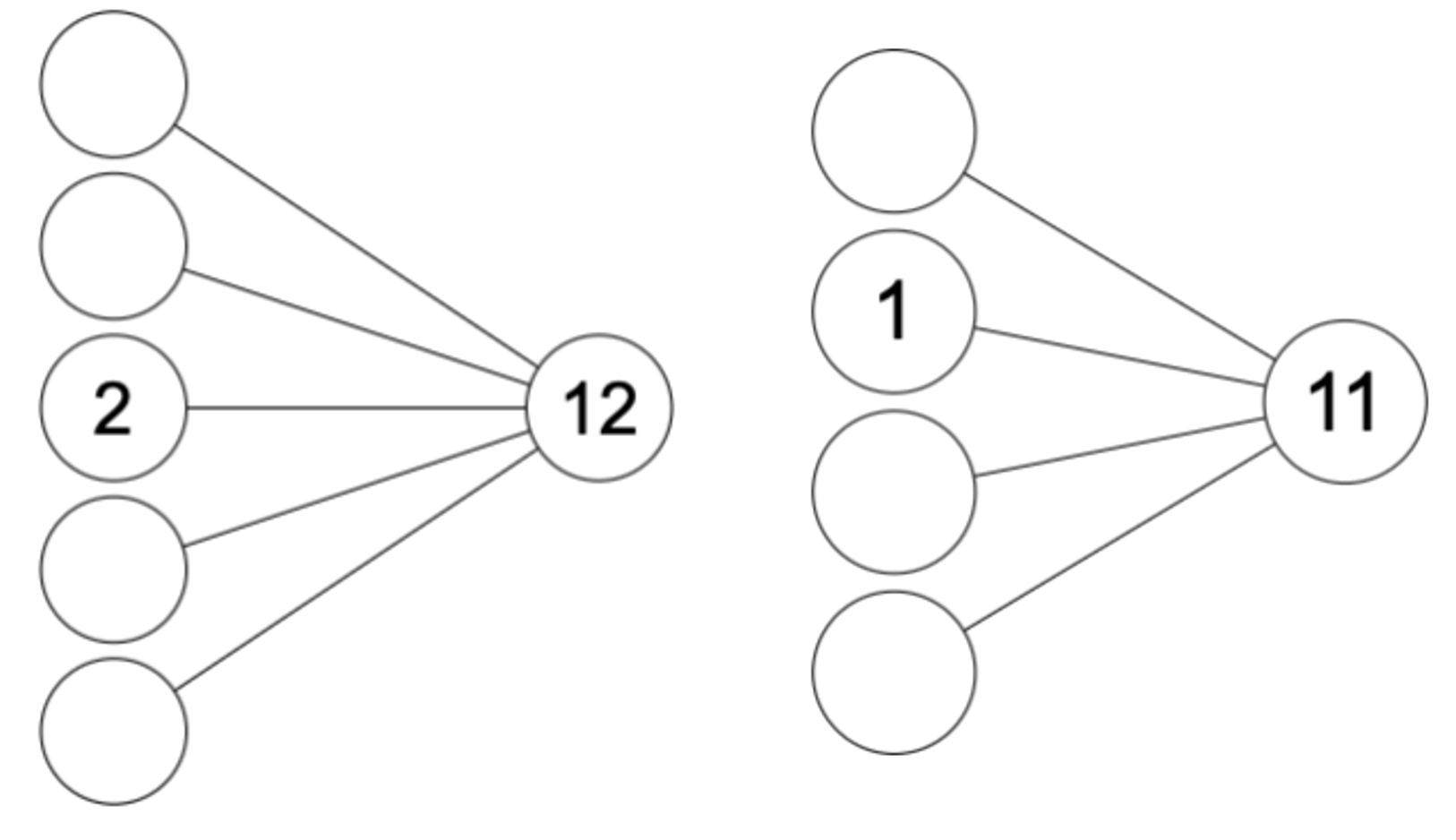
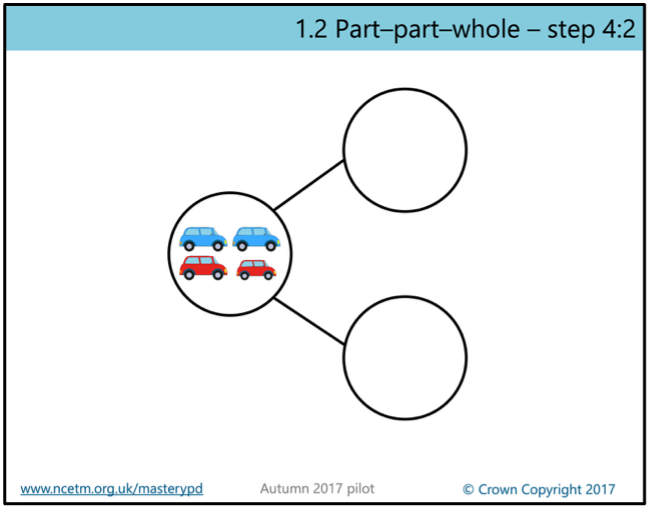
The part whole model promoted by NCETM, as you would expect is mathematically sound – a whole is made up of its parts and supports early understanding of addition and subtraction. However, is the visual used the most appropriate and has it become distorted, misused and potentially a distraction for learning with children – especially as it is not unusual to NCETM representatives, teachers, TAs and children refer to it as the ‘Cherry model’?
You will find examples, some with labels and some without, some in different orientations! From my experience cherries usually hang down on stems from a focal point/spur of a tree, not sideways or upside down as in this example from a school website. My concern continues when the text accompanying the image states “Cherry diagrams are often referred to as ‘part whole’ models in teaching maths” – will parents think Cherry diagrams are a piece of mathematics?
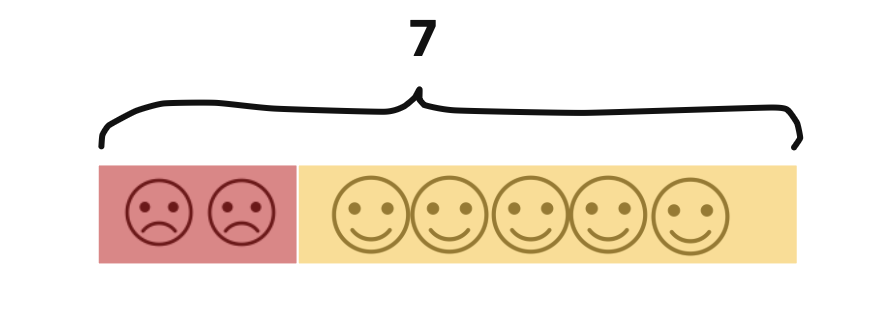
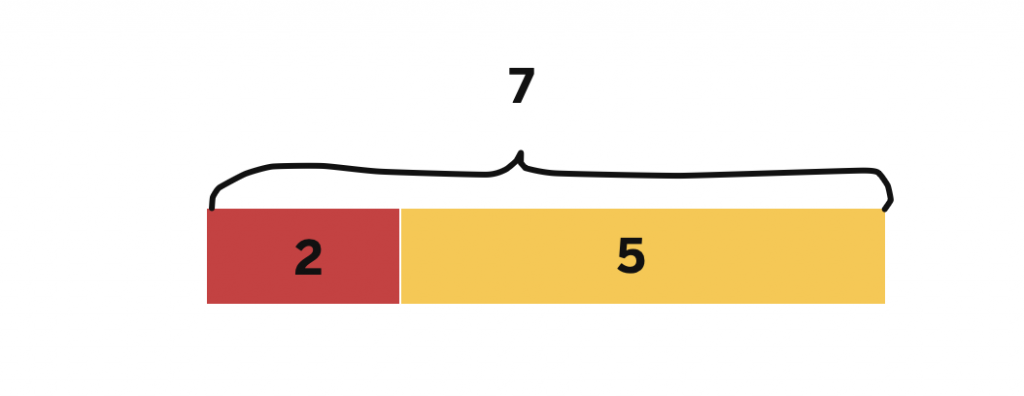
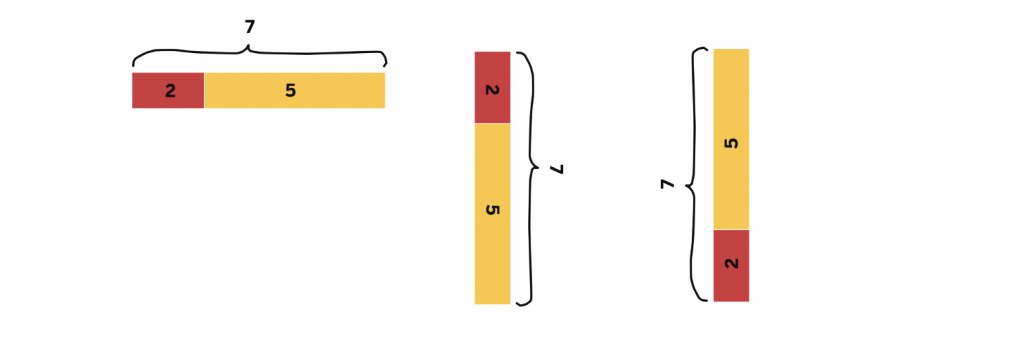
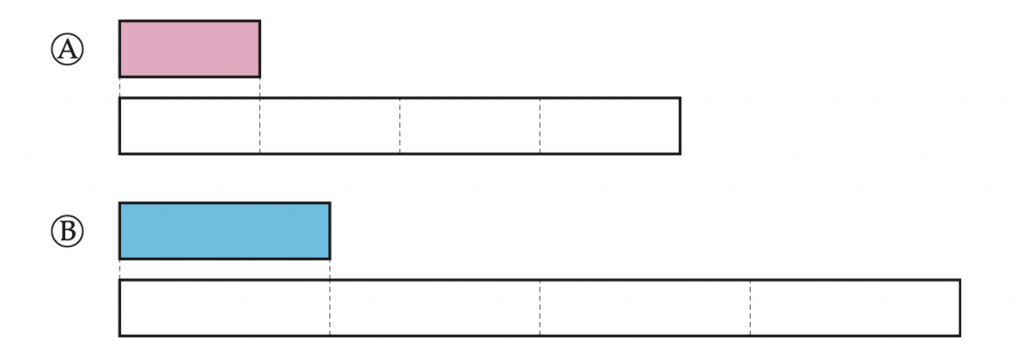
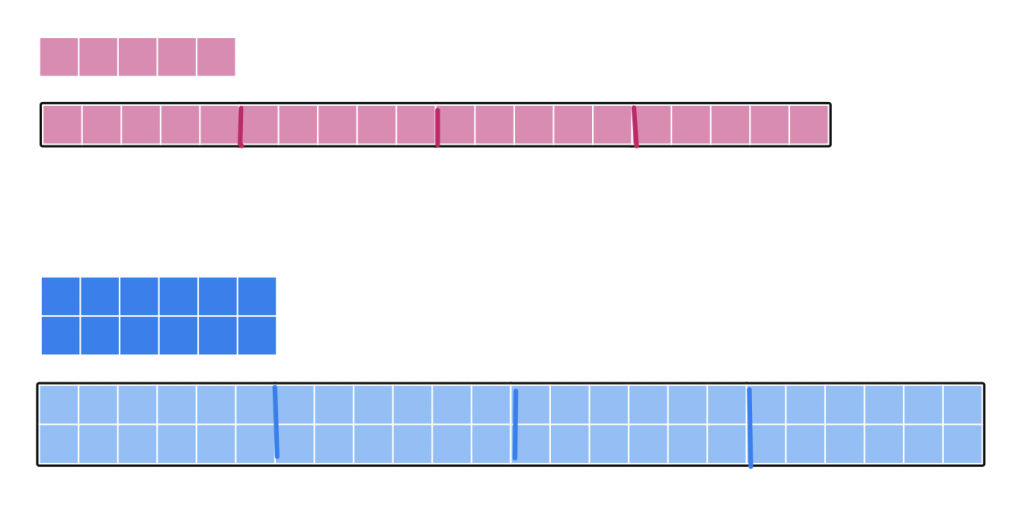
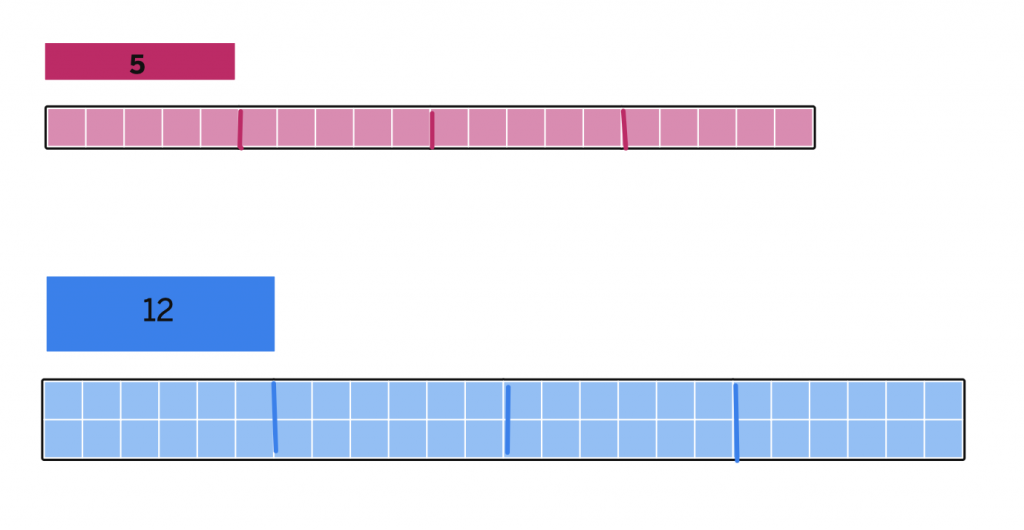
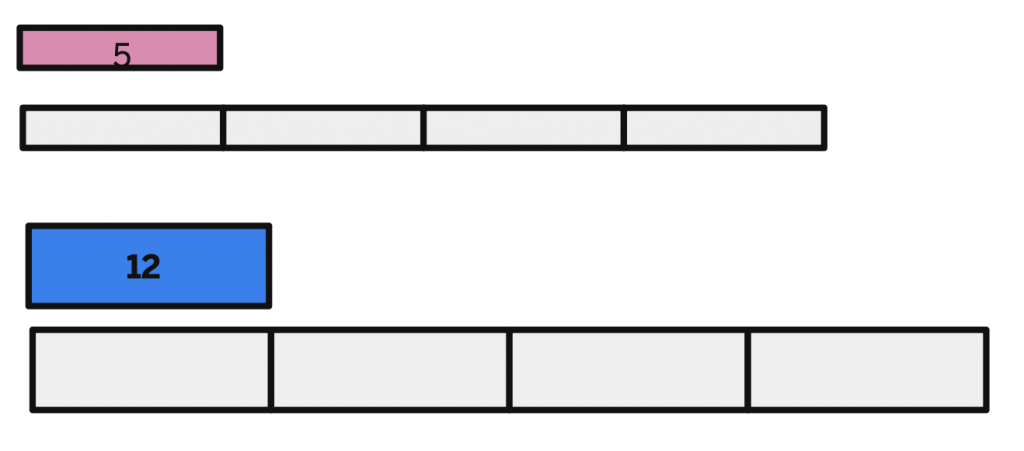
A more appropriate diagram IMO would be a linear tape diagram/bar model, as used in Japan, where the structure of the mathematics is in the visual. The opportunity to introduce this to young learners with objects/drawings represented in the partition can then progress to numerals.
The choice of colours in the example above links with the physical/digital resource of Cuisenaire rods seen below, which I would recommend, demonstrating the linearity of a bar model and a visual with clear mathematical structure .
Digital versions of the cherry diagram are available. One site offers diagrams having up to 5 cherries and different number of values already entered (not to mention the potential for up to 100 diagrams on a printable worksheet). The website refers to them as “Part- Whole Cherry diagrams”. I would question why anyone would consider the need to create a printable worksheet with 100 diagrams!
Website refers to them as Part- whole cherry diagrams
Children need to develop spacial awareness and therefore considering/recognising shapes in different orientations is appropriate. Using the tape diagram, the parts and the whole are self evident in whatever orientation positioned, unlike the ‘cherry diagram’ which has to be labelled to comprehend the intended meaning.
The cherry model is a non proportional representation, whereas the linear tape model even as a sketch conveys proportionality and supports further learning.
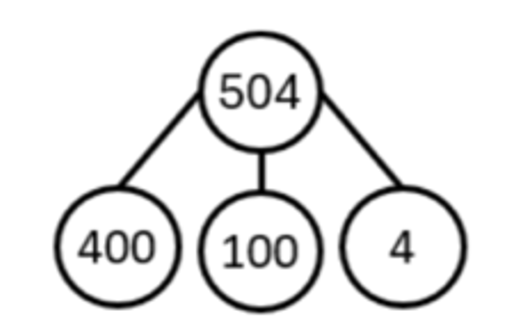
The example below is the representation from a problem solving question identified for KS2 & KS3 children described as showing partitioning of a large number.
I would suggest a linear tape model offering a sense of proportionality would be preferable? The tape diagram would offer a structural visual of the mathematics and support children’s access to the problem.
In conclusion
I would suggest the linear tape diagram, as used in Japan, should be the ‘go to’ representation for the concept of a whole and its parts, whatever number of parts you may want. Surely a model that makes sense from the beginning with an appropriate connection for KS1, KS2 and KS3 would be advantageous for developing mathematical ideas and progression.
The tape diagram makes the mathematics visible and supports ALL children in their learning by offering:
Children need coherence in the models/tools they meet, ensuring new models enhance their learning and understanding, as well as being developmental as they meet further mathematical content. The models are a key part of foundational knowledge, which all children need to understand securely, with the ability to visualise a scenario and manipulate it mentally being key. A consistent development of models, avoiding tricks and algorithms are needed if equity for children is to be achieved, especially for those with additional needs.
Every representation used creates the potential for a different and deeper understanding, but also for further misunderstandings or misconceptions. As such, as with mathematical concepts and contents, carefully scaffolded learning sequences should be developed for representations and the rationale and justification for choice of representation must be clear to children.
North, Dalby, Wake – Primary Maths Autumn 2020
I have identified two key devices and have exemplified their importance in a curriculum demonstrating continuity and coherence.
Array
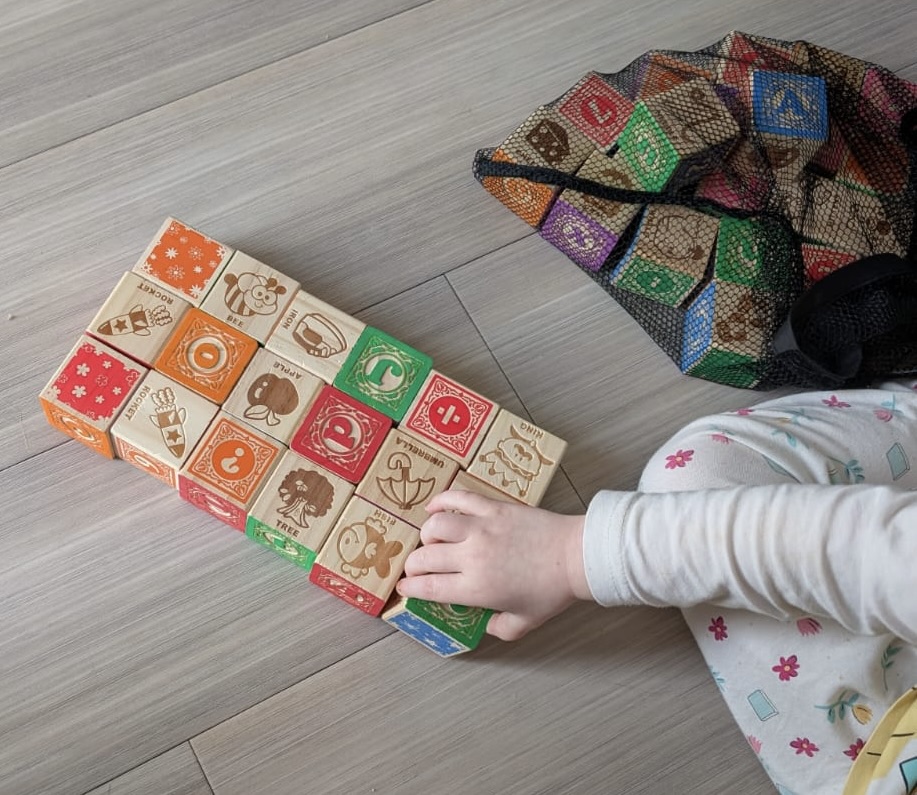
Children as young as 3 or under innately arrange blocks in an array without being instructed – exemplifying how the innate concept develops cohesively to the use as a mathematical array.
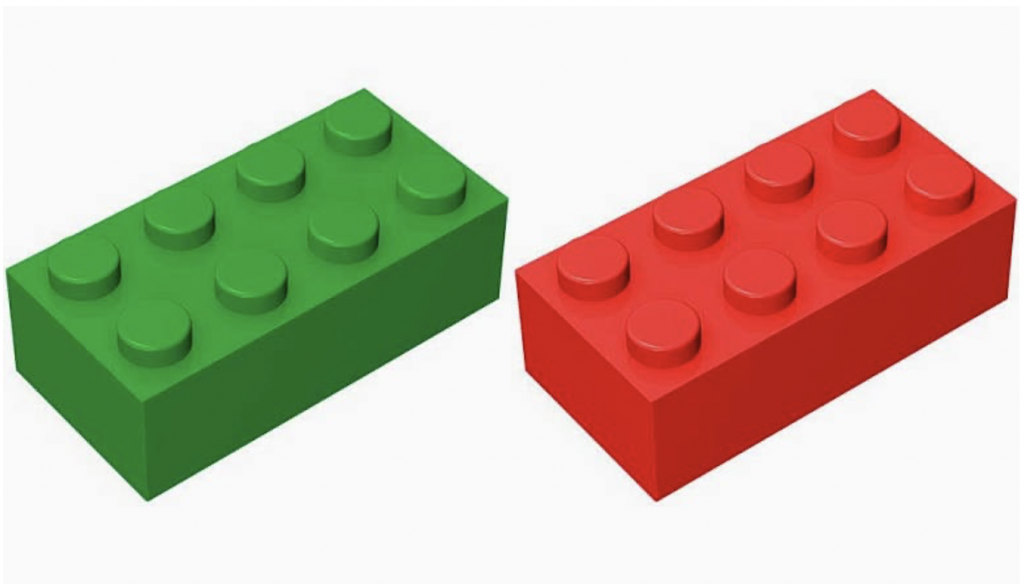
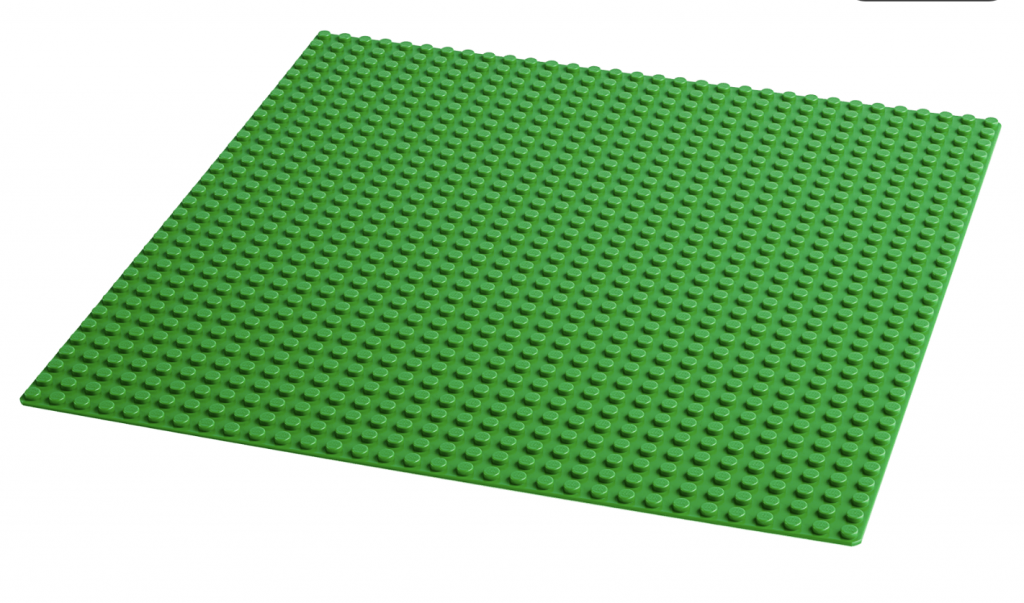
Children often play with Lego bricks which in themselves exhibit an array of stubs/bumps, with children seeking another brick with a similar array of stubs to join one brick onto another. With the Lego base board being an array itself.
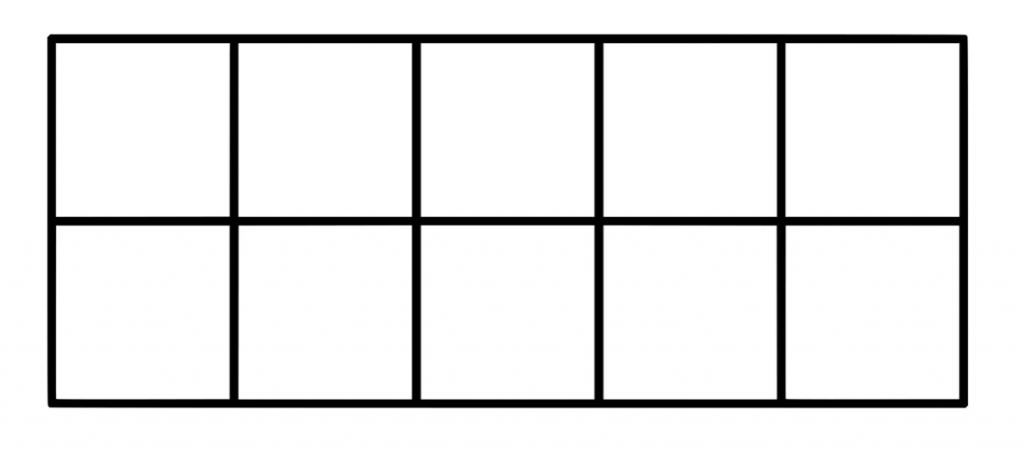
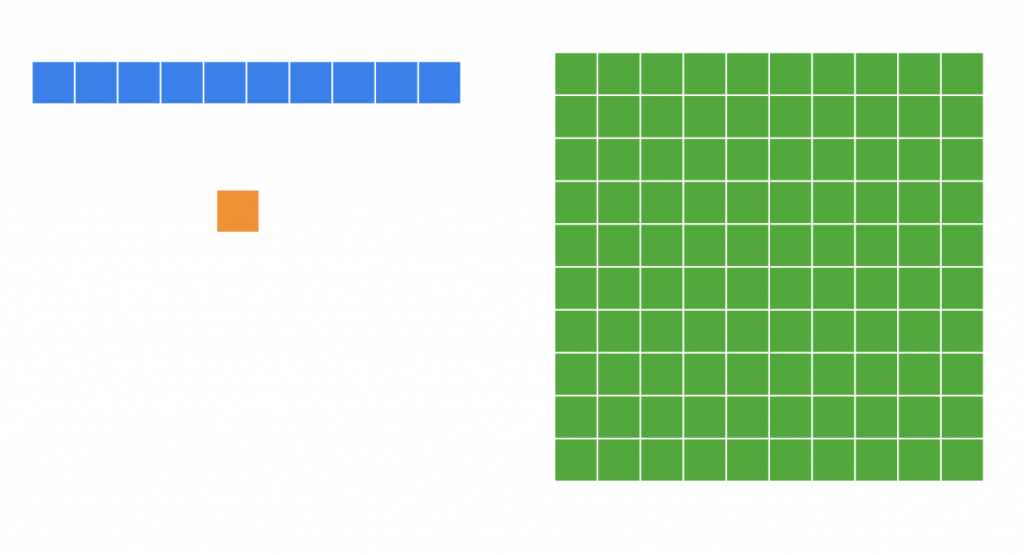
The tens frame used for number is itself an array, 2 rows and 5 columns, and cohesively links to the linear 10’s Dienes blocks.
The linearity approach in the Japanese curriculum connects with the repeated linearity in the Array.
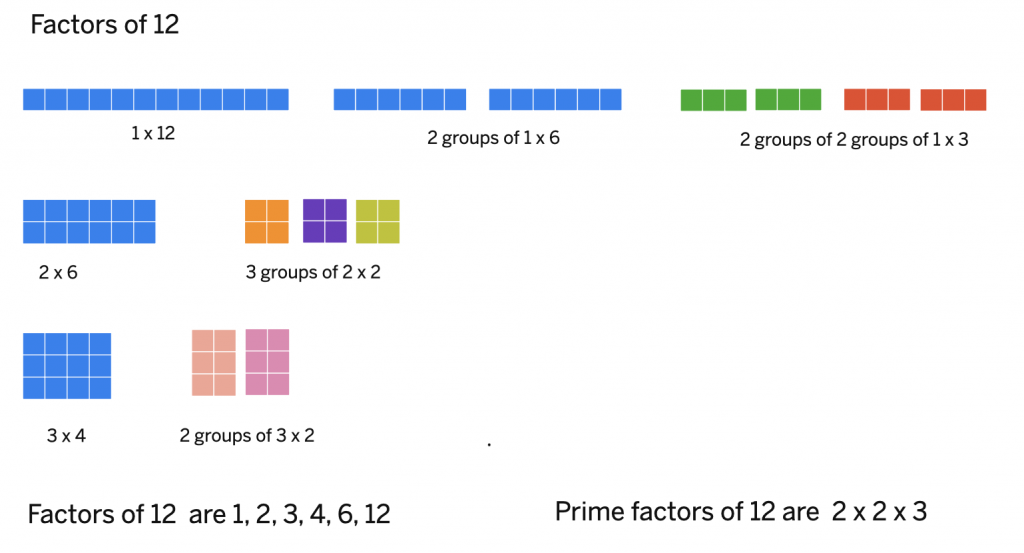
It is important for children to appreciate that when making different arrays of a number of dots/objects, the amount of dots/objects must be recognised as consistent for the multiplicative element and factors to be appreciated. Dynamic technology allows children to see the same 12 tiles in this example being arranged in different rectangular formats and in doing so the children can describe the dimensions of the rectangle which will contain 12 square tiles.
Similarly children can appreciate a non-rectangular arrangement and supporting their understanding of the structure of the number.
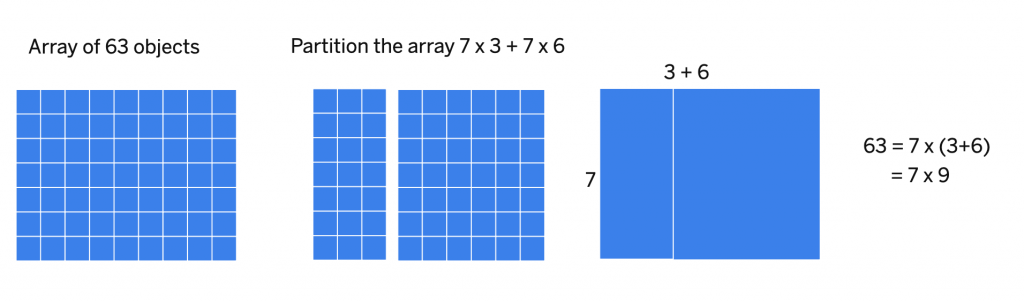
Multiplicative relationships, division and factors are structurally modelled using the array. An array model being a rectangular arrangement of discrete dots organised in rows and columns, being a visual tool that can be used to demonstrate how the arrangement can be split. The array is a precursor to the rectangular area model and ultimately to a rectangle with potentially continuous measurement – an example of coherence and continuity.
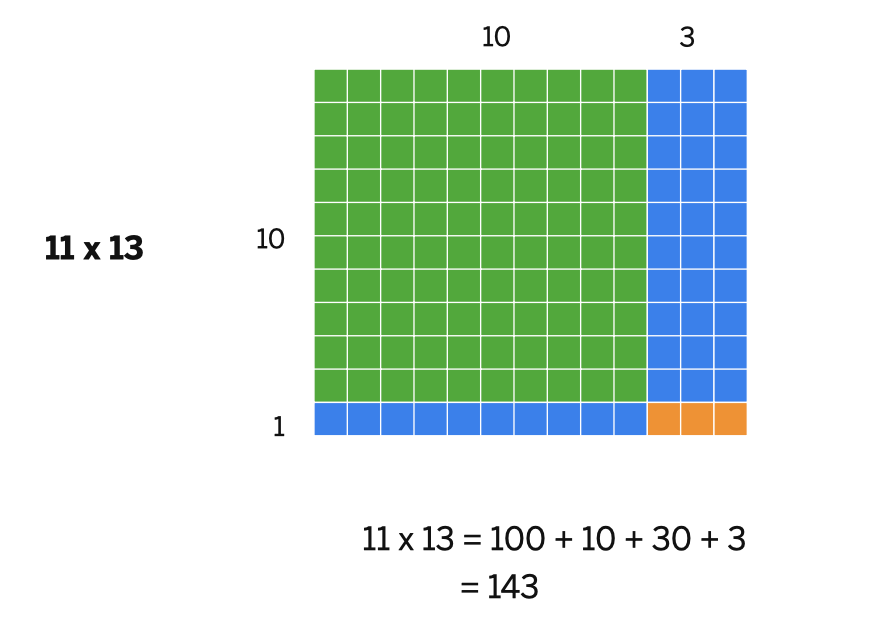
The array is the structure for the distributive law. The array may be partitioned in variety of positions. The distributive law is a key understanding for children as they consider variation and development of general forms for algebra.
The array is further developed using Dienes resources for multiplication.
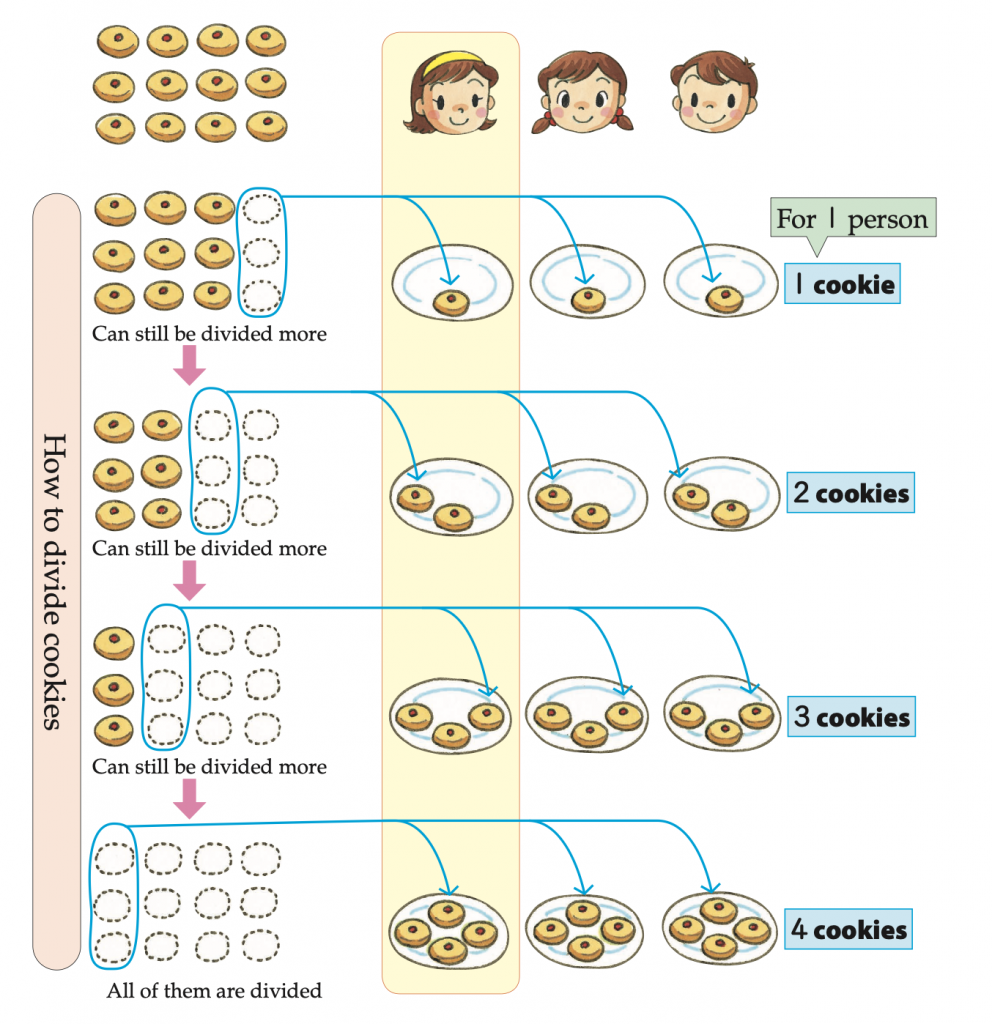
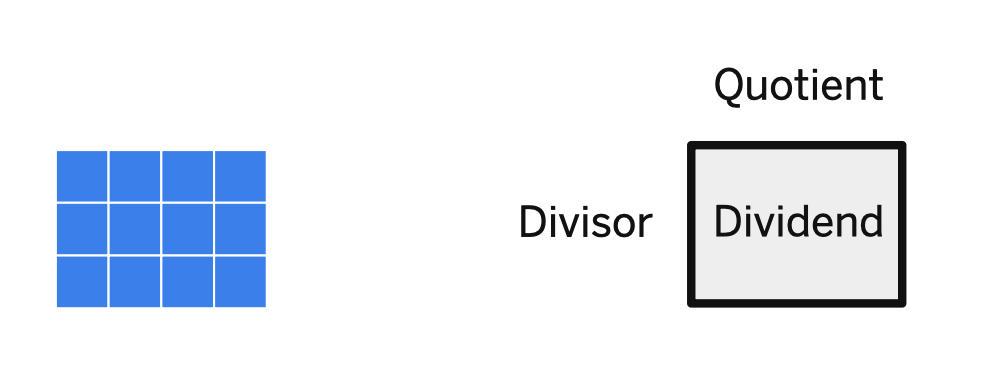
And for division the array evidences the structure for the sharing model leading to the area model.
The introduction of the Tape model as a scalar/multiplier allows children to move from the array to work with the numeric values but the scalar/multiplicative principle is the same whatever the dimensions of the array – the representation as seen below is an example of how the connection and linearity is enhanced – the Japanese call them tape diagrams. The tape model is the linear model preceding work with the number line.
Factors are often thought of as an abstract piece of mathematics, with children often confusing factors and multiples. However, when a visual is recognised/recalled it helps children make connections in the mathematics. The connections give children the confidence and fluency to use the mathematics in a variety of circumstances, problem solving including real life situations e.g. packaging, time management, design, music, scheduling.
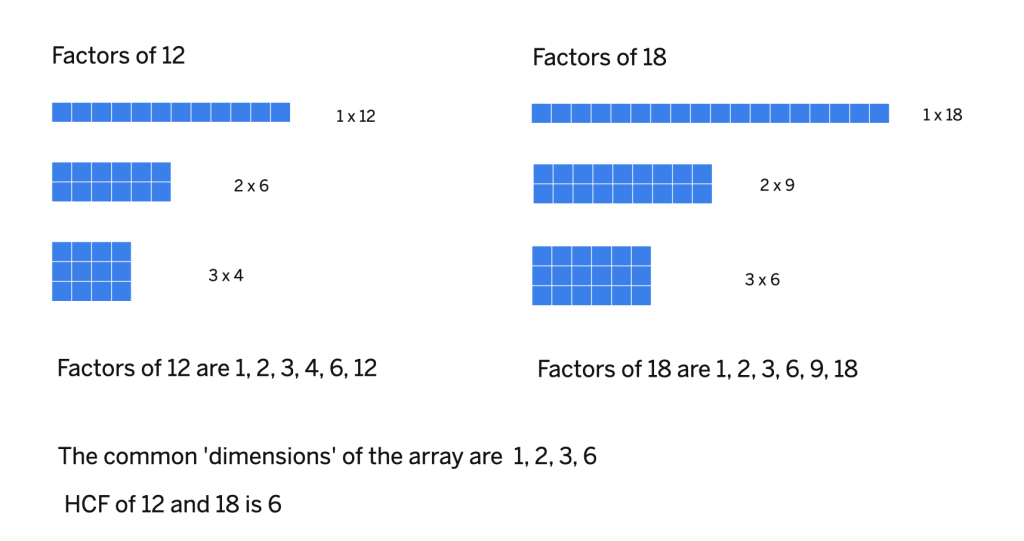
From the array the dimensions of the rectangle are the factors and the number of items in the array is the outcome of the multiplicative relationship of the factors. Thus for an array of 12 tiles, rectangles with dimensions 1 x 12 , 2 x 6 and 3 x 4 provide the factors of 12 being 1,2,3,4,6 and 12.
And comparison of arrays of a different number of items leads to the visual supporting a meaningful identification of the Common factors and the Highest common factor.
Representations and visual models help us to ‘concretise’ complex and abstract ideas. They provide hooks on which to pin understanding, support recall by providing memorable cues, and reduce load on working memory by providing succinct and systematic summaries of information and relationships
North, Dalby, Wake – Primary Maths Summer 2021
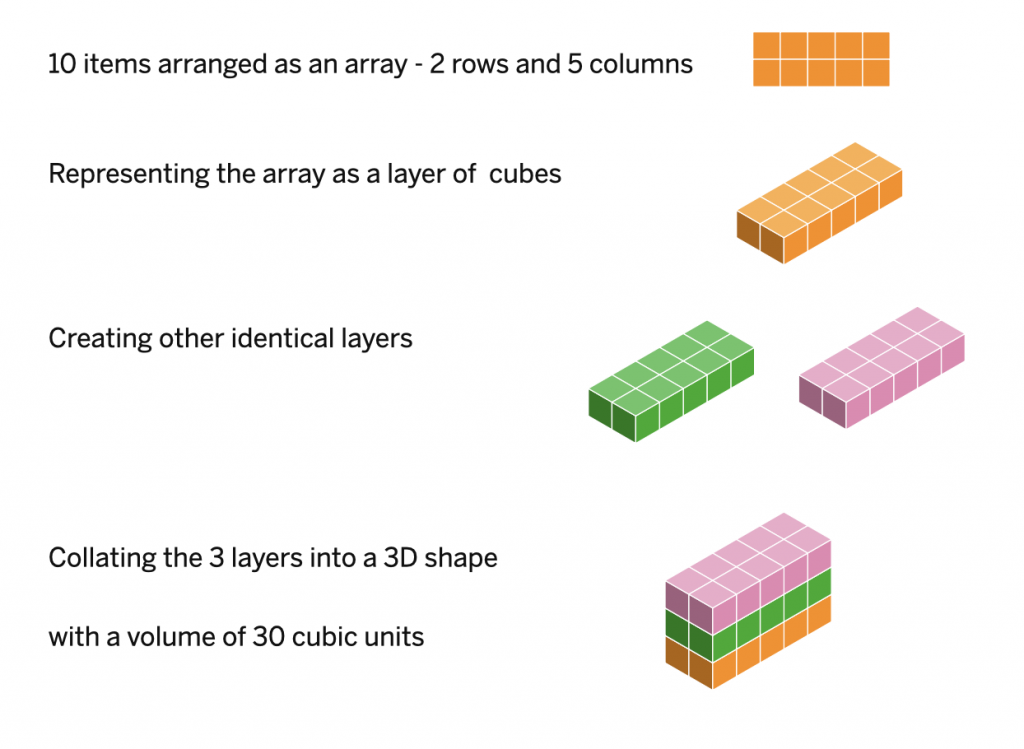
Items arranged in an array can be defined as a layer when considering 3D rectangular prism shapes. Each additional layer is creating the 3D model and the children can count the items in the array layers.
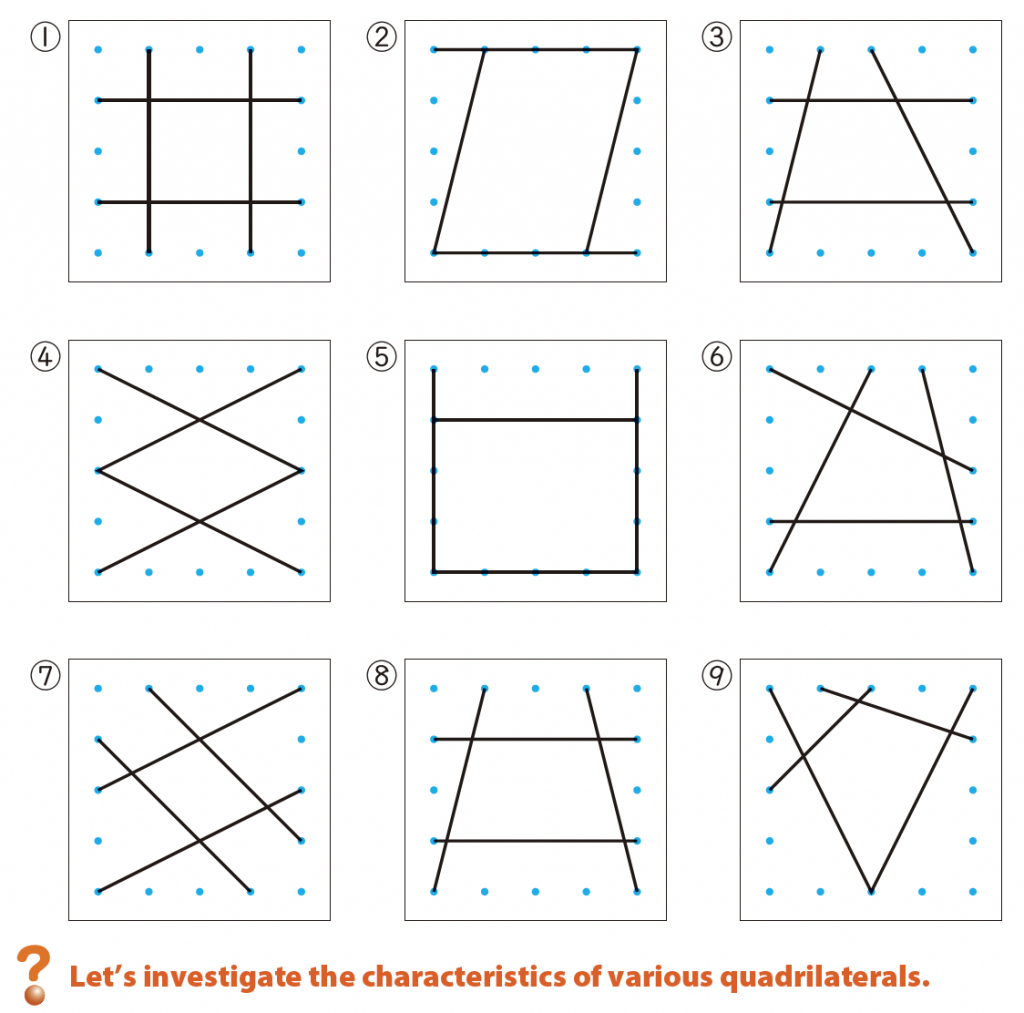
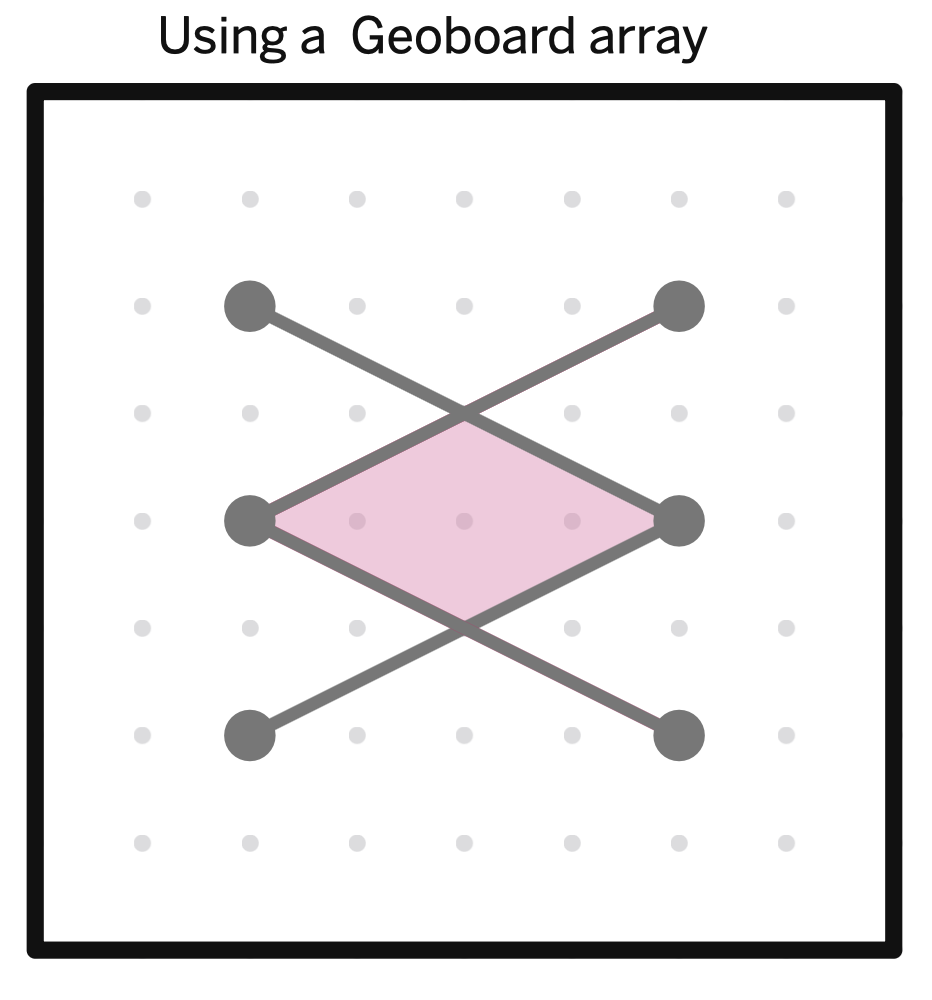
The Geoboard physical resource is an array of ‘pins’ used to develop children’s spatial awareness when using rubber bands to connect pins and make shapes. Using the Geoboard’s array can support identifying shapes based on the space taken up, relative positioning of lines, slope and the movement from one position to another – a precursor to translation vectors
Grade 4 in Japanese Text books
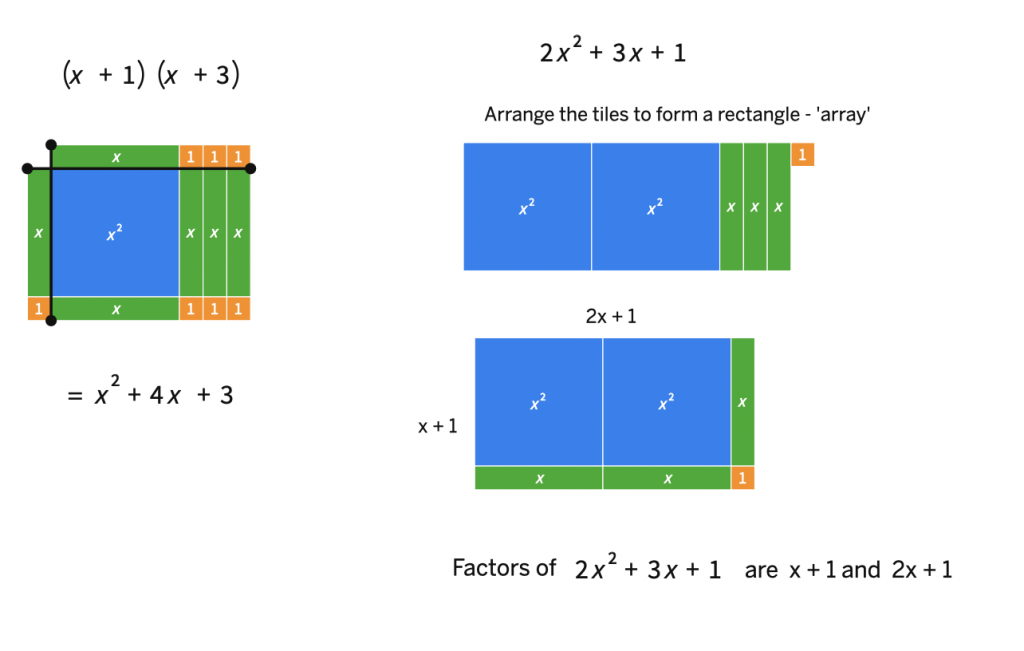
The array is the foundational structure for the area model which in turn can be further developed in algebraic manipulation using algebra tiles. Here with the expansion of brackets and also finding the factors of an expression.
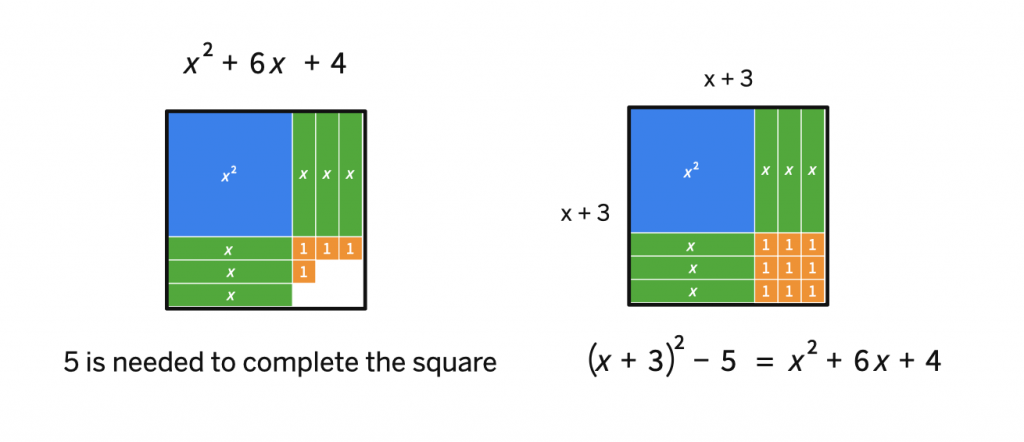
and completing the square with a visual, essential for appreciating the structure.
Linearity and the Number Line
Below are examples for consideration when developing a mathematics curriculum and sequencing in planning.
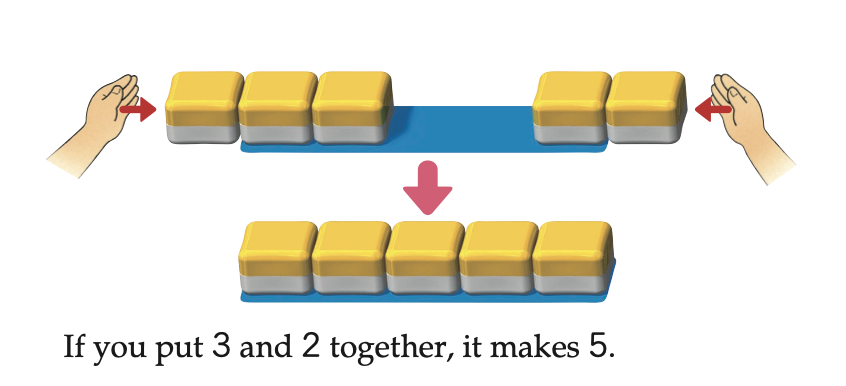
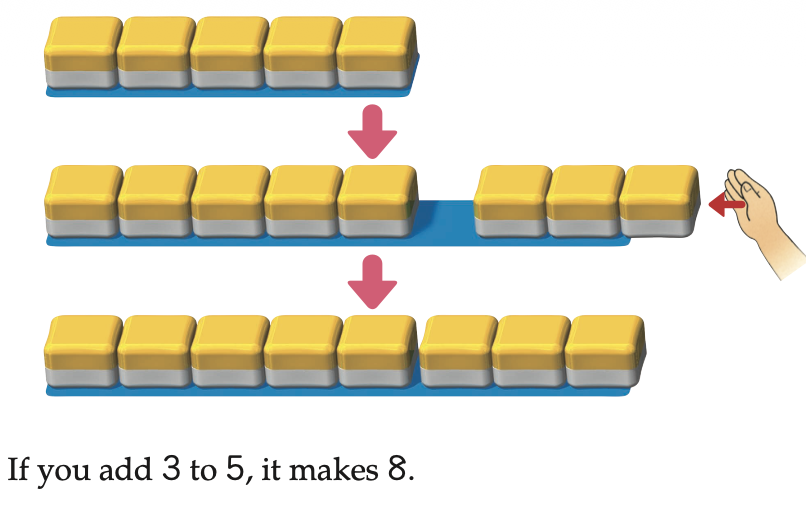
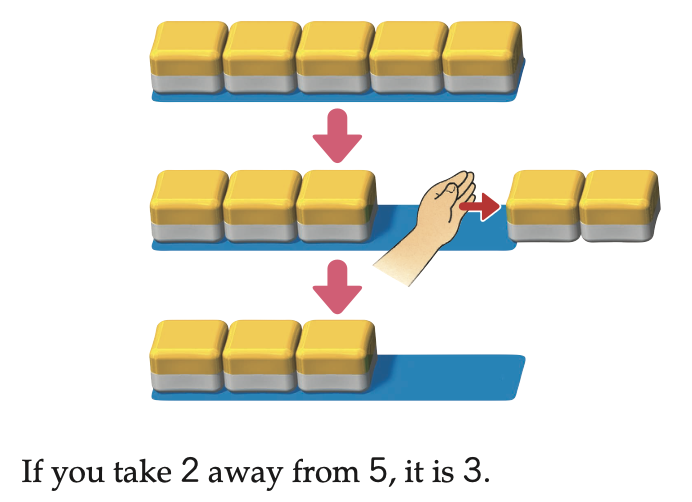
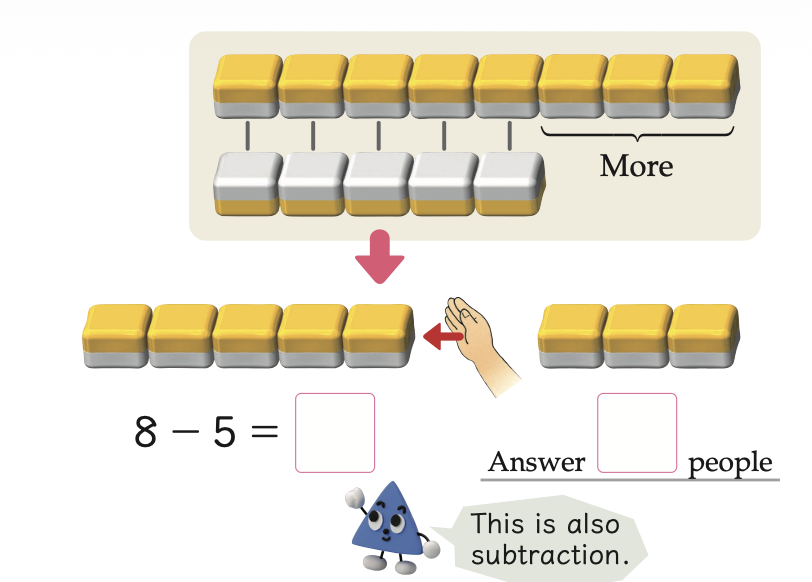
Linearity is key in the Japanese Curriculum – Grade 1 (Y2 in UK)
addition (aggregation and augmentation)
subtraction (take away – reduction and difference model)
Illustrating the physical gestures, is attracting and directing the children’s attention and aiding their recall of information (see Royal Society publication). Animated PPT slides rarely if ever include the hand movements indicating the gesture. Notice also that proportionality is maintained with the linear model.
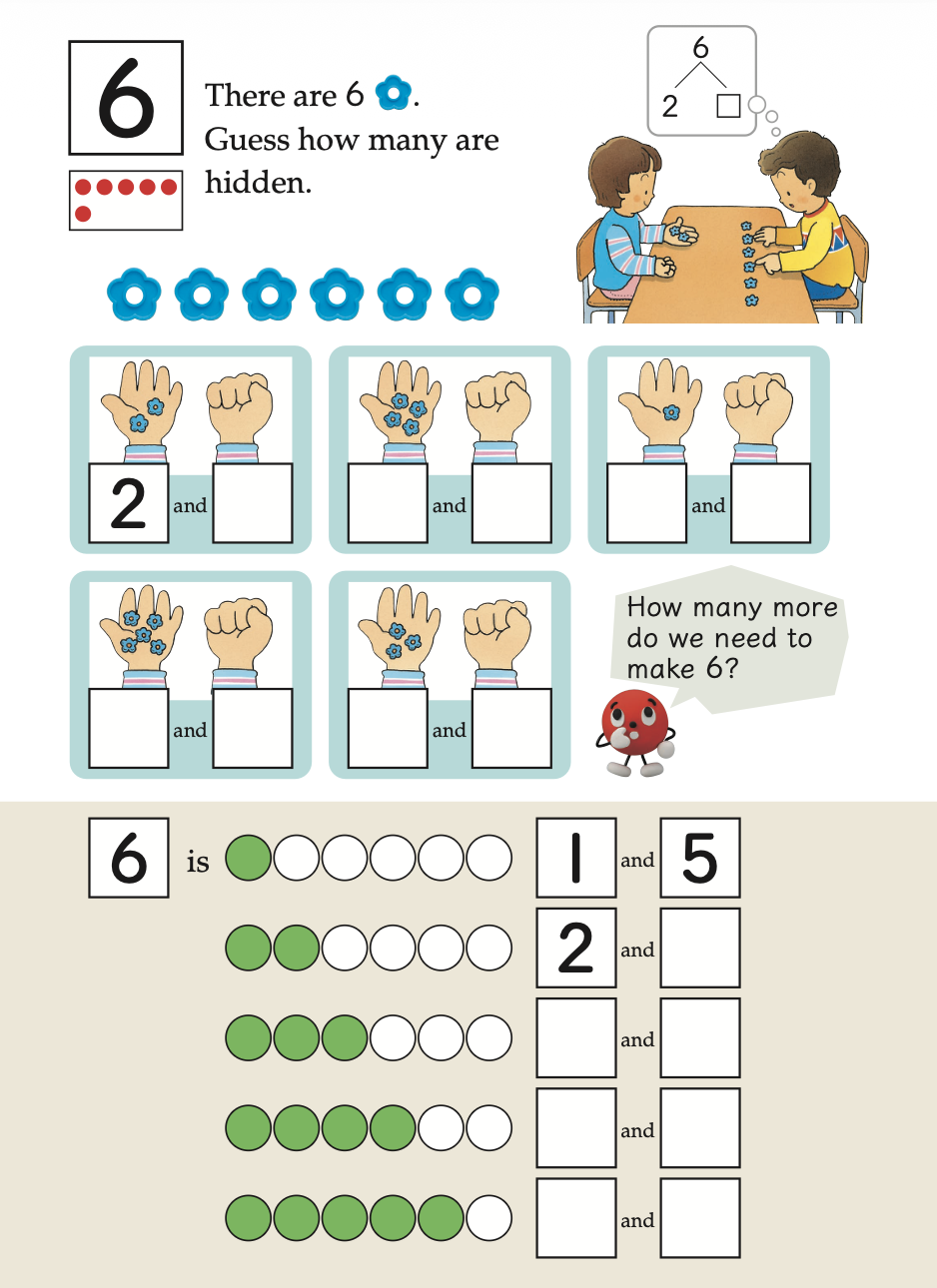
A practical example leading to the linear model for the whole and its parts is shown below, where the same linear model can used when there are more than 2 parts. Notice ‘thought bubbles’ are exactly that – explaining the child’s thinking, in the case below the child knows there are 6 flowers/counters in total but he can only see 2 being held in one hand by his partner. Therefore his thought is open to a variety of approaches, each valid and part of his developing a variation to aid further tasks i.e. ‘how many more than 2 is 6?’ or ‘what must I add to 2 to make 6?’ or ‘what is 6 take away 2?’ or something similar. We want to hear children’s thinking as they work.
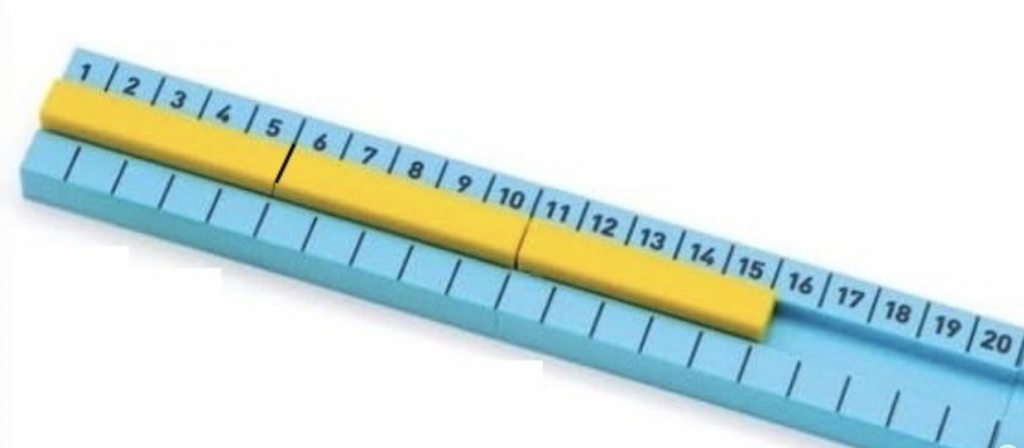
Cuisenaire rods are a supurb physical model to support the connection of the number track to the number line. With children making ‘trains’ of rods with the value/length of each train identifiable if placed on the number track. However the value assigned to the Cuisenaire rod can overtime be developed to be a variable, and children can work on a blank number line. This is the development of the tape diagram in the Japanese curriculum.
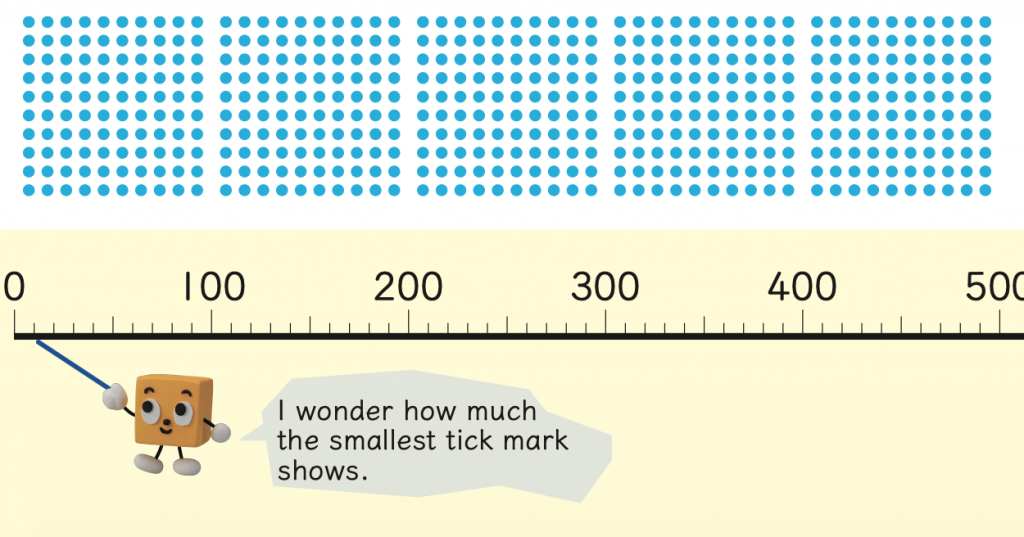
A number line is a straight, horizontal line representing numbers in sequential order, typically with evenly spaced tick marks. It serves as a visual tool for understanding numerical order, ordering integers/fractions/decimals, and performing arithmetic (counting, addition, subtraction). See below the array linking to the number line.
Below are more examples in context of the number line as a didactical device:
Time; The number line is a more coherent model when working with time as the continuity of the line is more obvious to children than working with a circular analogue clock.
Statistics; including where the number line is key for finding the range of a pair of numbers.
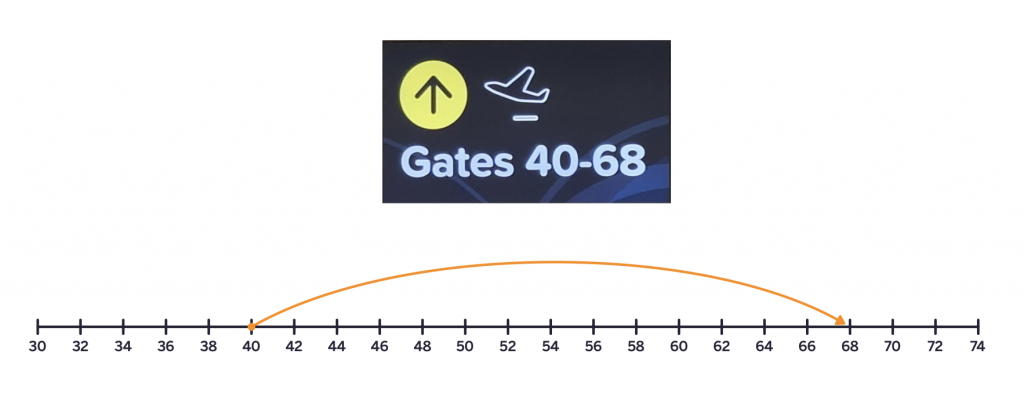
There are 28 departures gates if you follow this route.
Negative numbers; The introduction of the vector model for negative numbers is coherent as a precursor to formal vectors introduced at a later stage. Children appreciate the movement of magnitude and direction, with combination of vectors being a natural progression.
Ratio and Proportionality; using double number lines.
There are many more examples that could be included of where the number line is a key didactical device.
In summary:
Anyone wanting to design a coherent curriculum should include exemplification of key didactical devices such as the number line and array
Models causing misconceptions and mistakes
Cherry diagrams alone for Part, Part, Whole model – intended by NCETM to be used as an animated model, but frequently are not, do not evidence proportionality and are not connected with further mathematical content. The model would be improved if linear. If anything the model causes confusion when children are taught factor trees – another common practice and one not recommended!
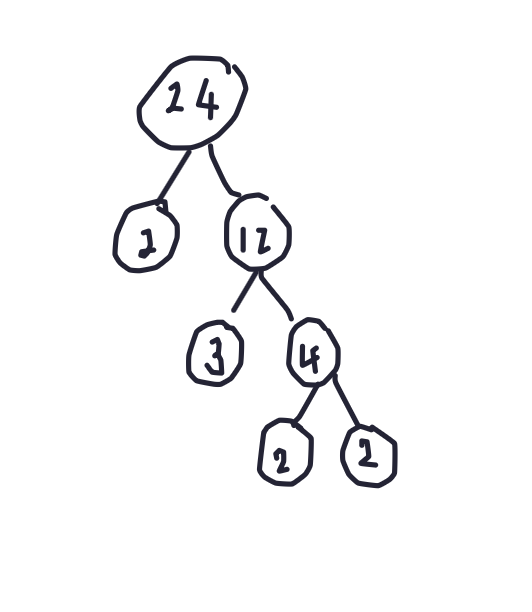
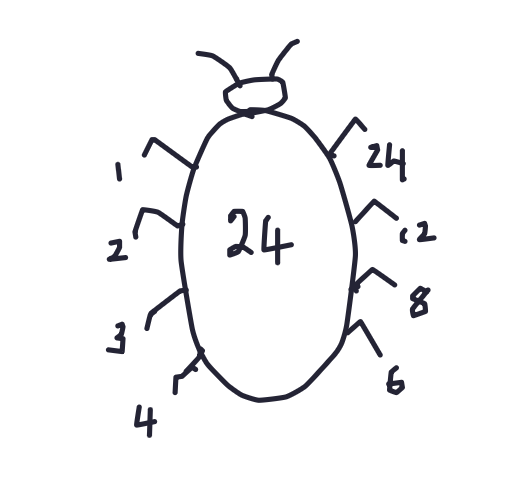
Factor Trees and Bugs
Factor Trees or Bug representations don’t provide insight into the mathematical structure of factors instead they provide a procedural method for finding factors.
North, Dalby, Wake – Primary Maths Autumn 2020
Typically bugs are presented to young children as ladybirds due to being ‘friendly and likable’ insects. The additional confusion created when using this model is ladybirds and most insects have 6 legs, yet the bug in the example had 8 legs! This is yet another example of where the science is not connected with the mathematics.
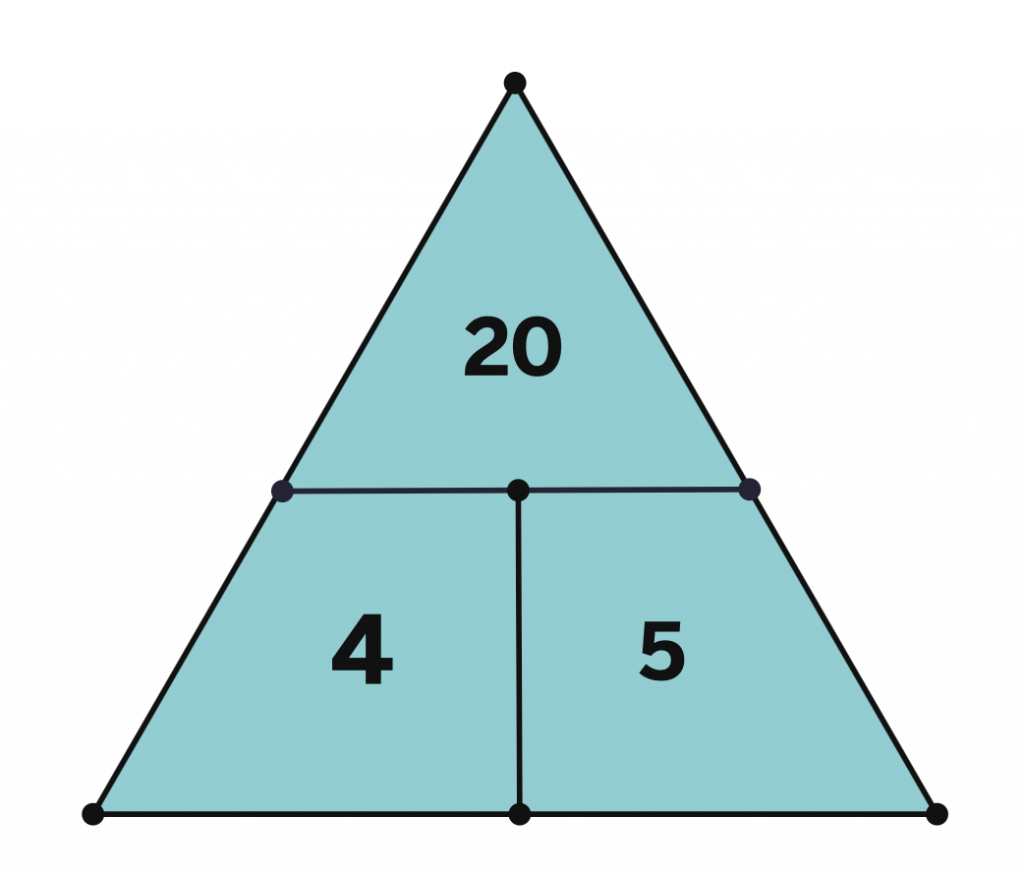
Factor Triangles where children are shown the triangle to represent multiplication. Does the largest number have to be at the top? What link does it have with the structure of multiplication? Multiplication connects with an array and area model!
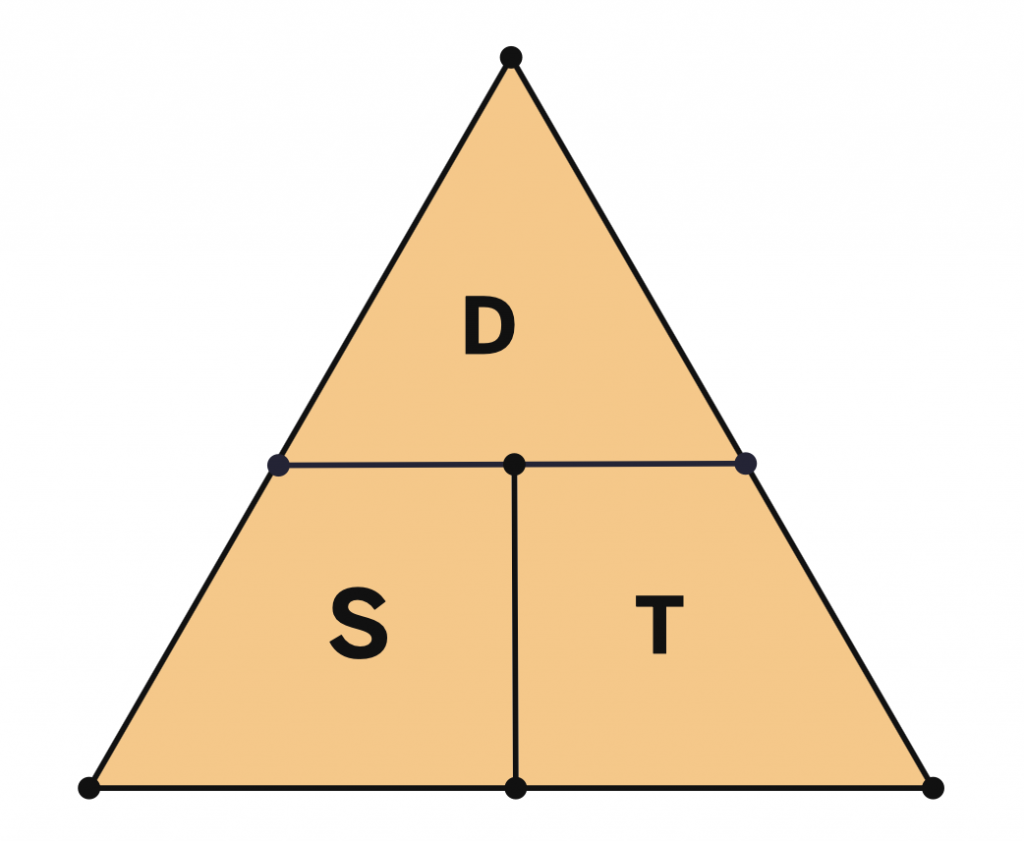
Speed Distance Time Triangles where children are taught the mnemonic in the diagram below. However evidence shows children frequently do not remember to put the letters in the correct position and therefore the triangle is not usable. Children do not have the understanding that a speed of 20m/s is actually relating the metres travelled in the number of seconds (number of metres ÷ number of seconds) and therefore to recall the units of a measure would be more valuable. The emphasis on units being used is important in the Japanese curriculum. The SDT triangle is something highlighted as needing to avoid in the recent work in T&L of Mathematics and Science by NCETM workgroup leads.
This is not an extensive list of examples to use and those to be discouraged. However the quote below stands as a good summary
Carefully chosen representations accurately reflect the mathematical structure under investigation, supported by familiar contexts that ground engagement with abstract mathematical concepts in familiar experiences, help children develop visual models on which to pin their understanding.
Many years ago I learnt the Japanese greeting おはよう先生 Ohayō sensei – “Good morning Teacher”, from a pupil who joined my class speaking very little English. Now was my turn to say “Ohayō sensei” to the visiting group of Japanese teachers who would lead this CLR (Collaborative Lesson Research) day in London. With the assistance of Associate Professor Dr Taro Fujita from Exeter University who translated, we were provided with a superb insight into the Japanese approaches to curriculum design and pedagogy in the teaching of mathematics Grade 1 – 6 (Yrs 2 – 7 in the UK).
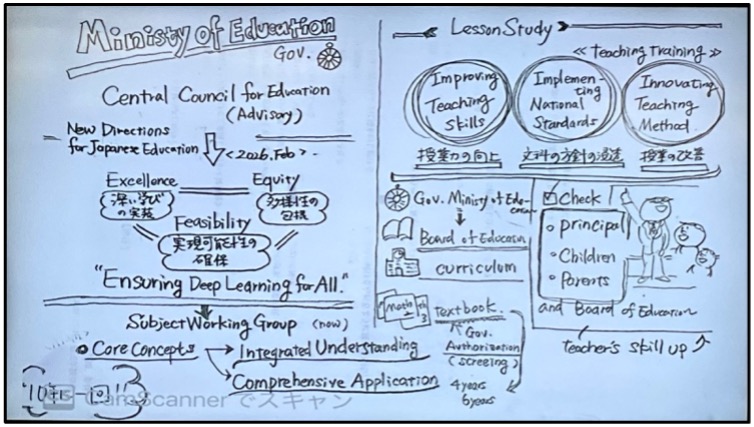
Throughout the day, the importance and influence of ongoing academic and school based research was apparent. The Japanese curriculum has a ‘10 year life cycle’ with changes considered and developed by a series of experts over time with a focus on establishing excellence, equity and feasibility. The involvement of academics and school based lesson study is clearly integral to how changes are considered before implementation – securing the evidence for when change is needed!
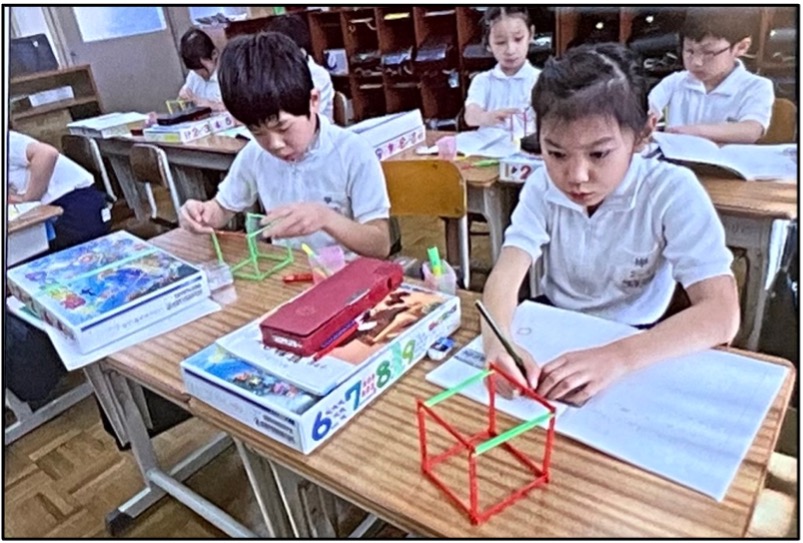
Four areas of mathematics are identified in the Japanese curriculum – Number & Calculation, Shape, Measurement/Change & Relationship and Data Utilisation. The government provide their approved text books for every child to keep, the content of which is trusted by the teachers and used to plan the daily 45 minute mathematics lessons. There is a notable absence of a deck of PPT slides provided, teachers craft their lessons based on the text book and reflect on their effectiveness in the classroom through the lesson study approach. The text book may not be used in the lesson but is available for children to use outside of the lesson. Also of note is each child is provided with their individual box of ‘resources’, manipulatives needed for the lessons.
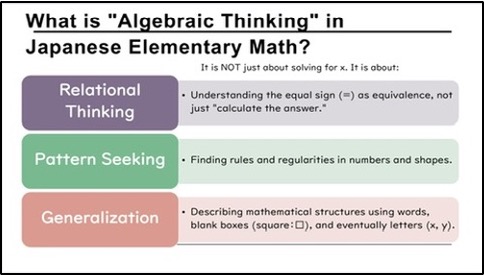
The curriculum focus of the day was ‘Developing Algebraic ways of Thinking in Elementary Schools’. Children thinking is a critical feature of the Japanese lessons, and generally the allocation of time given to develop and secure specific concepts is more than in the UK. Algebraic Thinking is deeply embedded in the realms of ‘Number & Calculation’ and ‘Change & Relationships’, with Relational Thinking, Pattern Spotting and Generalisation secured before formal algebra is introduced in Junior High school (Secondary phase in UK).
With so many ideas to be drawn from the day I have chosen just two to illustrate key points that took my attention.
The Tape Diagram
My first example of continuity and coherence in the Japanese curriculum is the development of the ‘Tape Diagram’.
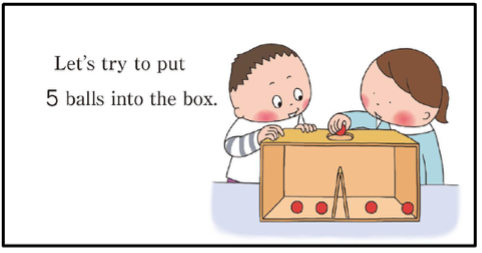
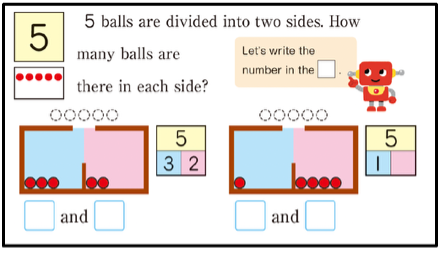
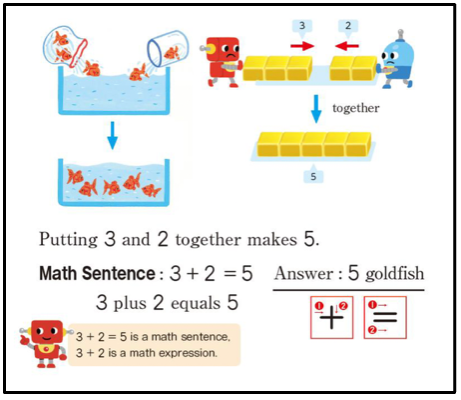
In 1st Grade children approach composing/decomposing numbers through practical tasks and storytelling, representing the situation with blocks (cubes), pictures and developing a mathematical sentence/expression to describe the relationship and subsequently using to finding an unknown value.
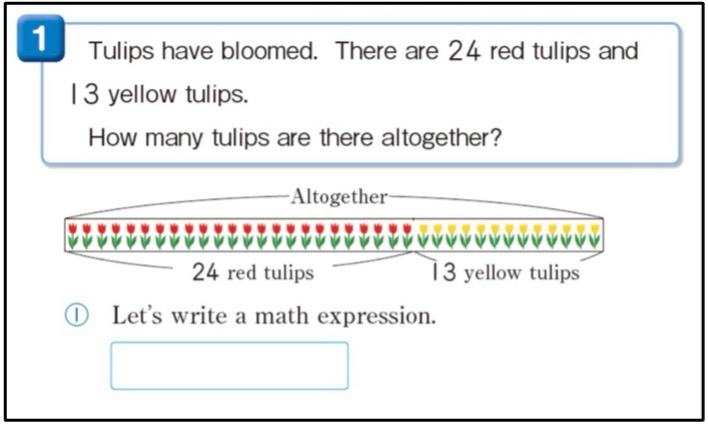
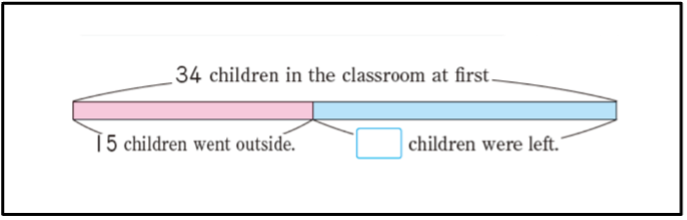
In Grade 2 the linearity of these representations continues with the evolution of the Tape Diagram. Semi–Concrete framing, where the picture is in a rectangular frame to group items as a continuous quantity, leading to removing the pictures to create an Abstract Representation – the Tape Diagram. The Tape Diagram is the model children use for visualising the part- whole relationship and subsequently working with the inter-relationship of addition/subtraction and multiple expressions representing the same relationship.
Notice the specified thinking – two expressions each with a distinct purpose.
Mathematics expression to find the children left 15 + 🔲 = 34
Mathematics expression to find the answer 34 – 15 = 19
This coherence in the Japanese ‘linearity’ model naturally leads to the introduction of the numberline (kazu no sen 数の線), potentially reducing the cognitive load. The number line is used as a tool for showing the relationship between numbers rather than for answer finding.
The Japanese approach is a subtle but important difference, improvement in my opinion, to the UK’s NCETM Part-Part-Whole model, introduced at Y1, referred to as the ‘cherry model’ which is non-linear. Teachers in the UK use the ‘cherry model’ in different orientations and this representation does not have that natural flow, offered by the Japanese approach, to the numberline. Additionally, the naming of the whole and parts in the Tape Diagram can be developed to preserve the proportionality of the story and in the use of inequalities, which is not evident in the ‘cherry model’.
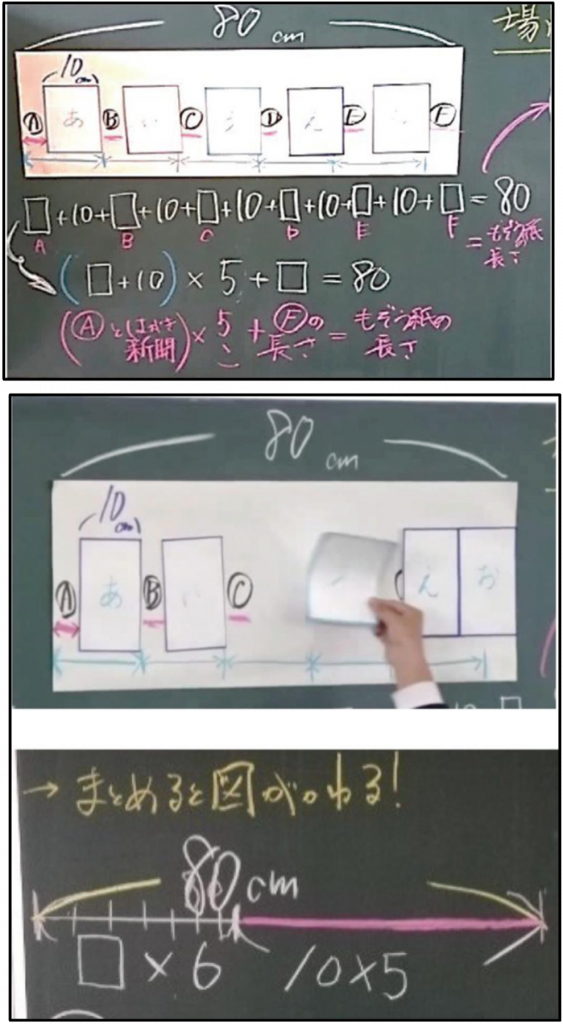
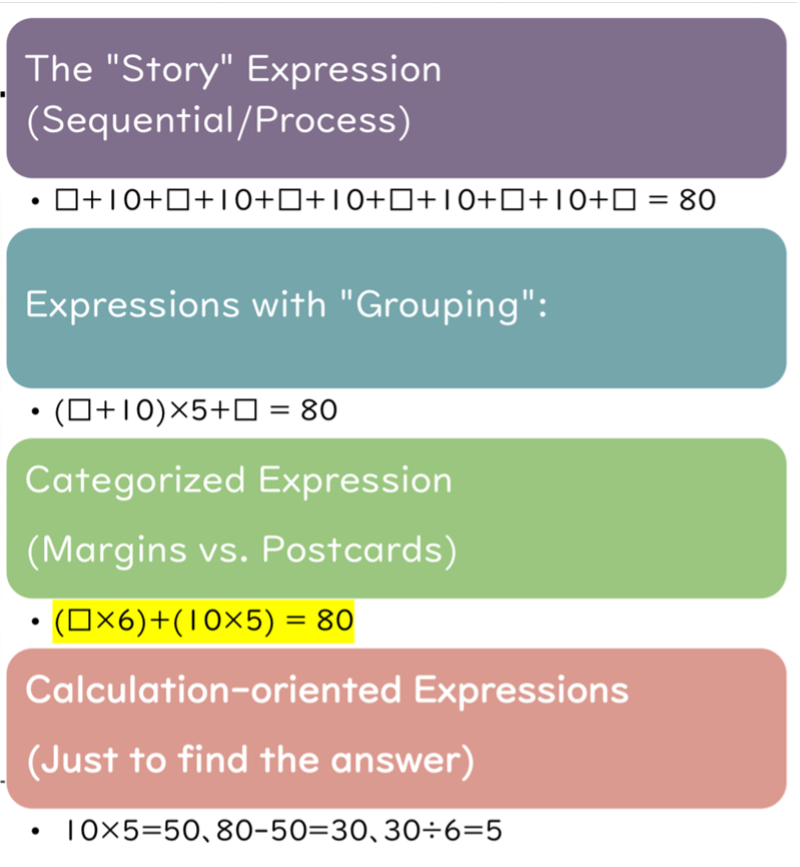
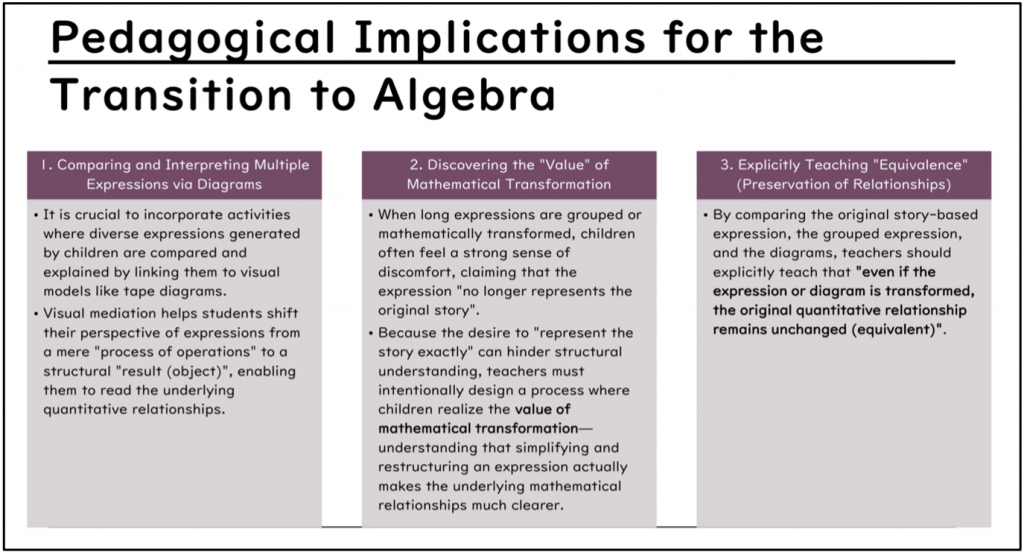
In Grade 3 the emphasis on Relational Thinking maintains the link with the numberline when Japanese children meet the preservation of relationships in transformed expressions shown in this Grade 3 (Y4 in UK) task/problem:
Example of how the problem developed can be seen in these ‘Bansho’ – board writing, the outcome of the children’s ideas and solutions.
N.B. Physical manipulative & writing on board
Again note the distinct expressions – to represent the relationship and to find an answer.
The Highlighted text – indicates where children are resistant to the transformation but visually supported through the physical moving of the postcards.
Habits of Mind – Mathematical Behaviours
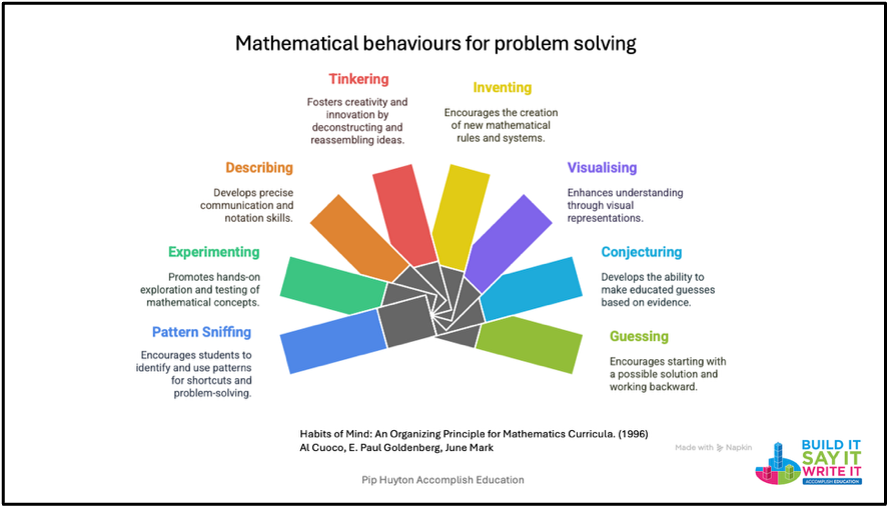
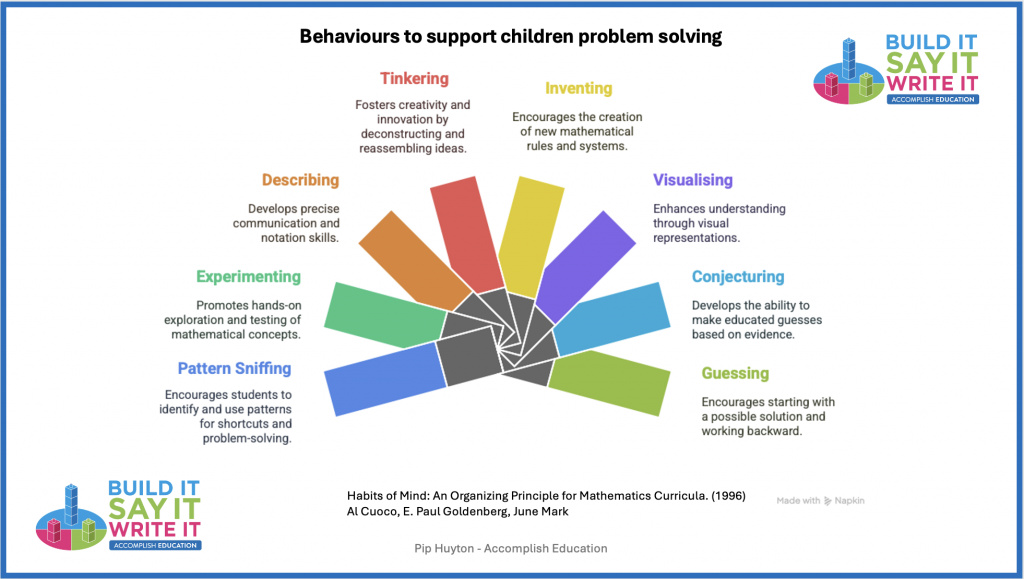
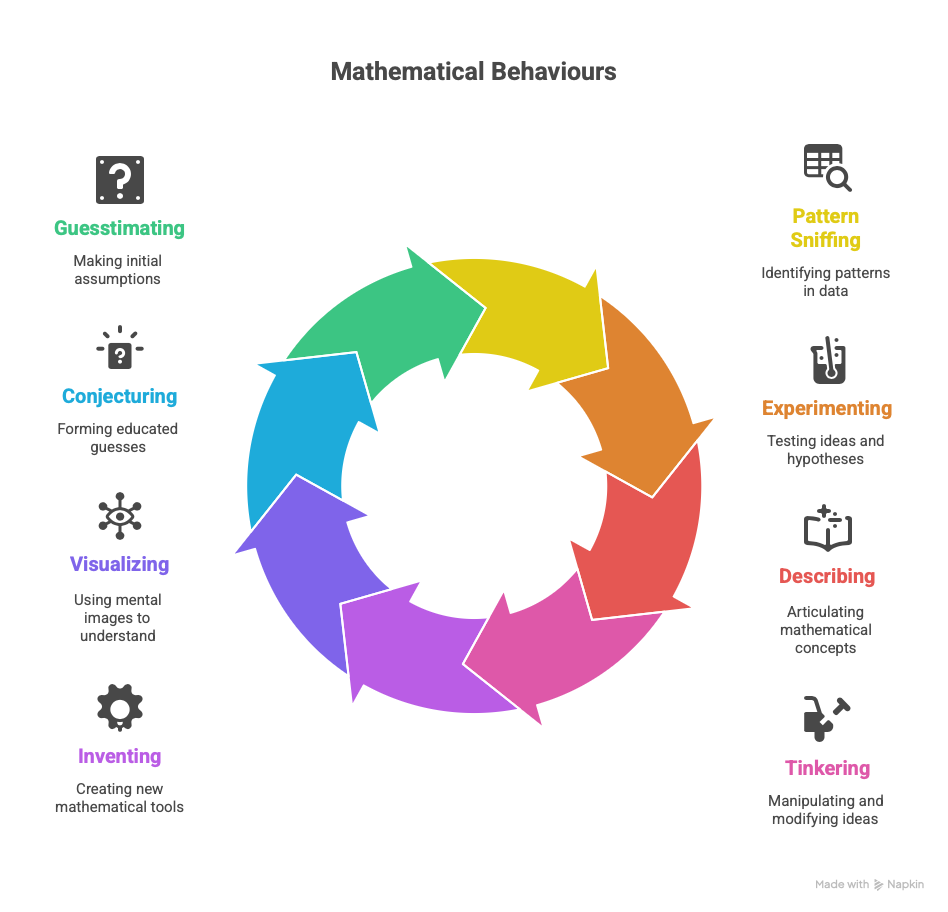
My second example relates to my long held belief in the importance of children developing mathematical Habits of Mind (Cuoco et al 1996). Today’s evidence of the Japanese curriculum reinforced to me how these behaviours are encouraged through the embedded expectation for all children to think, reason and explain at all stages of their work.
This example from the day, starts with a context which is most likely not familiar to those in the UK.
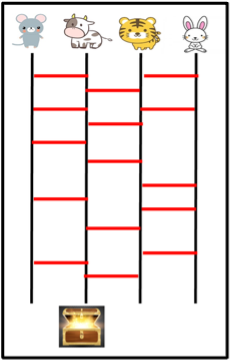
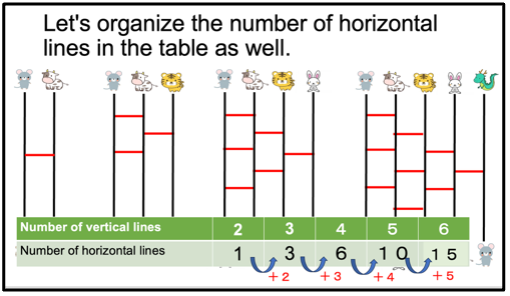
The Amida lottery, or Amidakuji (阿弥陀籤), is a traditional Japanese ladder-climbing game used to randomly pair items. It consists of vertical lines with horizontal “legs” connecting adjacent lines. Participants choose a top starting point and follow the path down, crossing horizontal lines (turning sideways) to reach a resulting end point.
N.B. You must turn sideways when you come to a horizontal line. E.g. The mouse would get to the treasure.
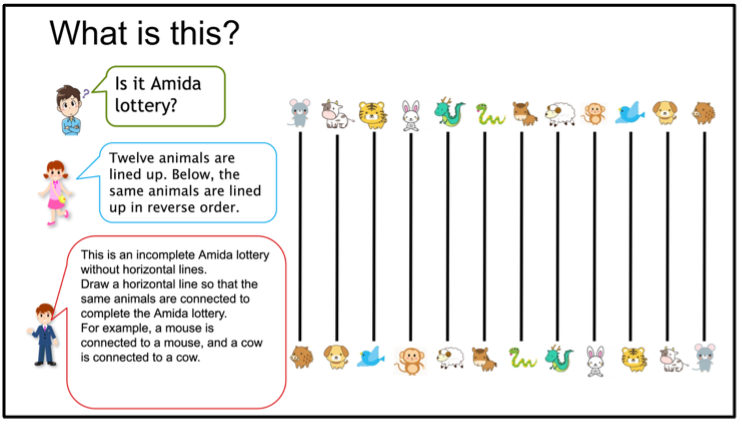
This Grade 4 (Y5 in the UK) ‘Amida Lottery’ problem solving task, gives children the opportunity to use and demonstrate mathematical behaviours, learn from collaboration with their peers, identify the mathematical structure and for the algebraic thinking to be developed:
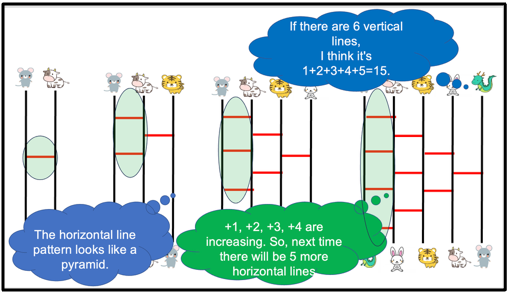
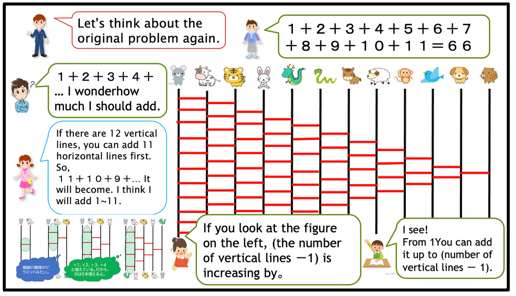
With the learning outcome illustrated below.
Children collaborate and develop their Relational Thinking, Pattern Seeking and Generalisation through
Strategising – start with a more manageable number of animals
Exploring – try different arrangements and reflect on the representation
Noticing and describing – articulating observations and ideas, pattern spotting
Recording – sharing their ‘if and when’ observations to build a cohesive response to the task
Conjecturing – following their ‘I think’ statements to a general case
(As well as drawing the connection to triangular numbers, which everyone on the day noted with a loud “ooh nice triangular numbers”).
These elements are recognised in the Japanese curriculum as being integral to the algebraic thinking being developed and appropriate time is allocated for this to be achieved. With the current focus in the UK following the Curriculum and Assessment Review on offering a richer curriculum with problem solving at its heart, there is much to be considered from the Japanese curriculum. In my opinion the pedagogy of ‘Problem solving’ should be included in the recommendations/changes. Time allocation and classroom organisation will help, but for all children to have the opportunity to use their prior knowledge in a problem solving situation, develop critical analysis and and in the process develop their mathematical thinking a fundamental change may be needed.
Other take aways from the day:
All teachers are ‘singing from the same page’, be it with their own ‘tone’ of voice.
Equity and Oracy are at the forefront of planning in their mixed-attainment (heterogeneous) groups. With lesson study considering not only what the teacher says and models but how the children respond.
Collective learning is encouraged where children discuss and solve problems together at the desk and on the board.
The high level of subject knowledge of all teachers was distinct.
A couple of surprises:
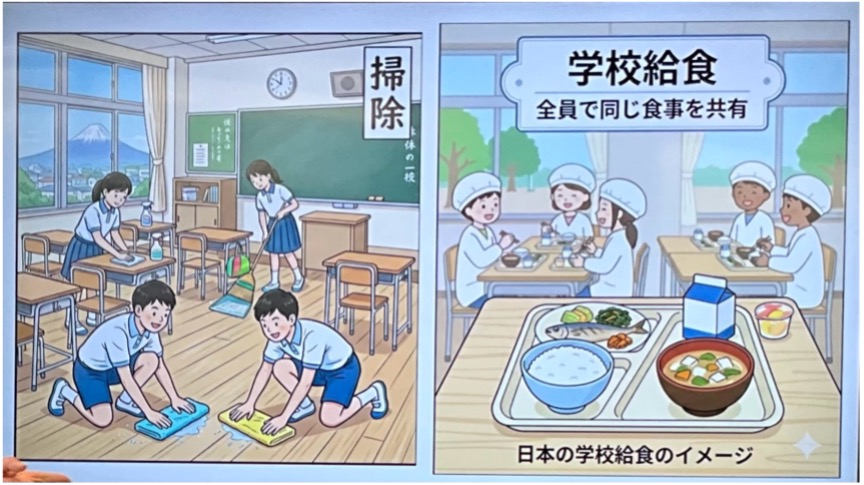
Children are responsible for their classroom being kept clean
Lunch is a learning experience – ‘Food Education’, is not ‘grab and go’. All children eat the same supplied food (subject to allergies) which is nutritionally balanced, for all children to learn about the importance of healthy balanced diet and to communicate with all their peers – seating groups for lunch are planned by the teacher and changed weekly.
What do we need children to understand in order to evidence reasoning and problem solving?
If reasoning and problem solving is associated with Higher Order Thinking Skills (HOTS) in Blooms Taxonomy, what is needed for there to be EQUITY for ALL children?
What behaviours do we want children to demonstrate?
What teachers/adults can do:
Listen carefully to what children are saying and encourage them to articulate their thinking – part of the Oracy approach
Encourage children to use representatives and pictures to support their exploration, thinking and reflections – Manipulatives for Visualisation and SpacialReasoning
Provide tasks and opportunities for children to demonstrate the behaviours proposed by Cuoco et al
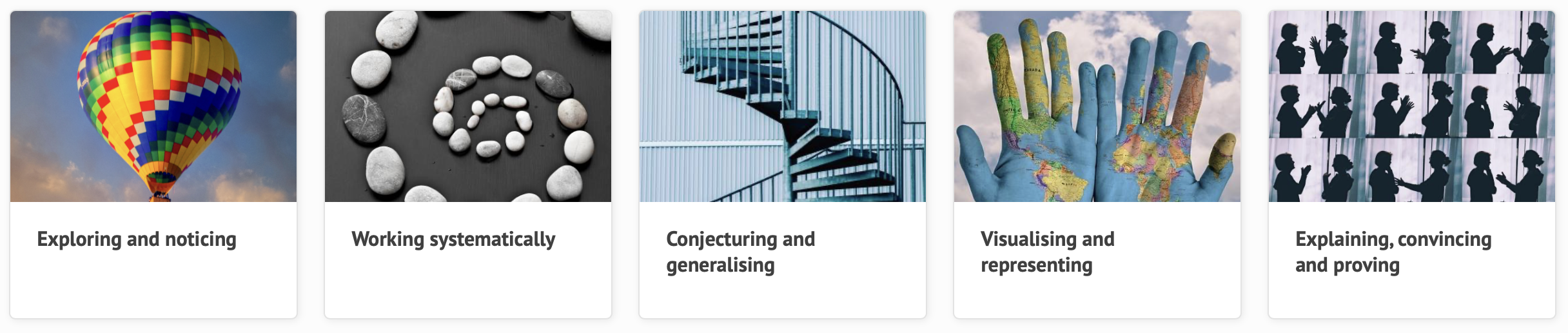
Nrich maths identifies the following approaches when working on problems:
Image from Nrich maths – www.nrichmaths.org
Technology can support development of reasoning and problem solving, with the capability to:
provide representations/manipulatives that may not in the moment be available in the physical form for visualisation
record children’s approaches to the task, as they work – Strategy
record children’s thoughts articulated as they are working -Oracy
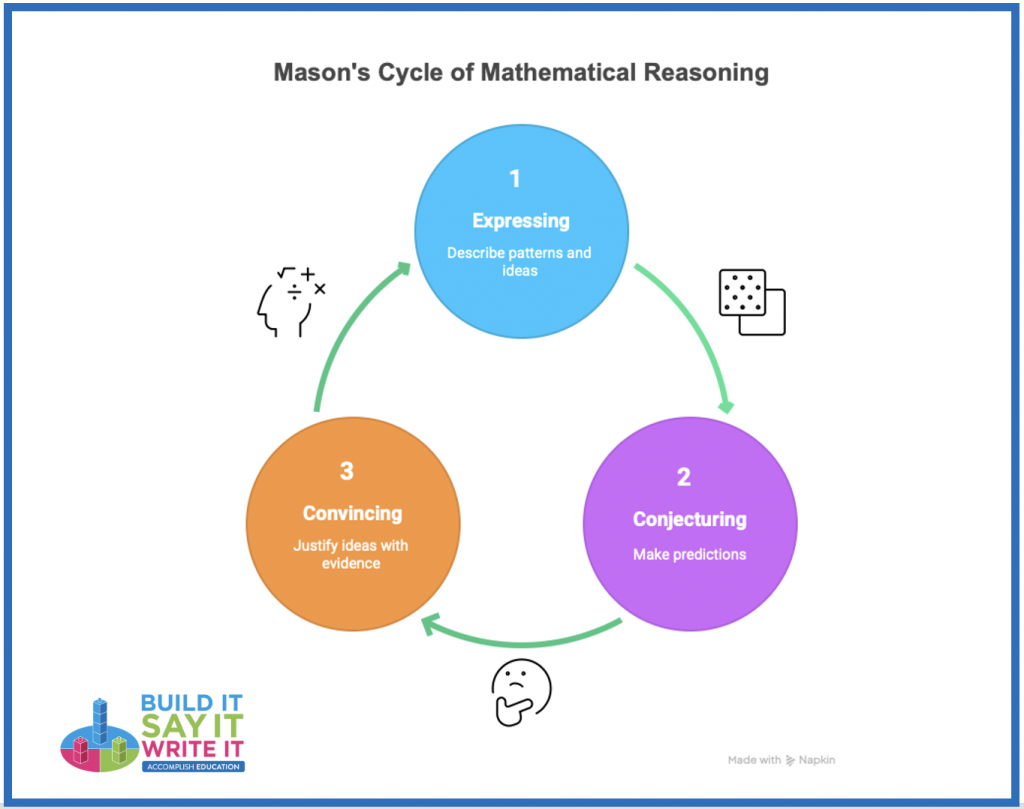
apply the principles of John Mason’s approach to Problem solving – Thinking Mathematically (Mason, Burton & Stacey) 1982.
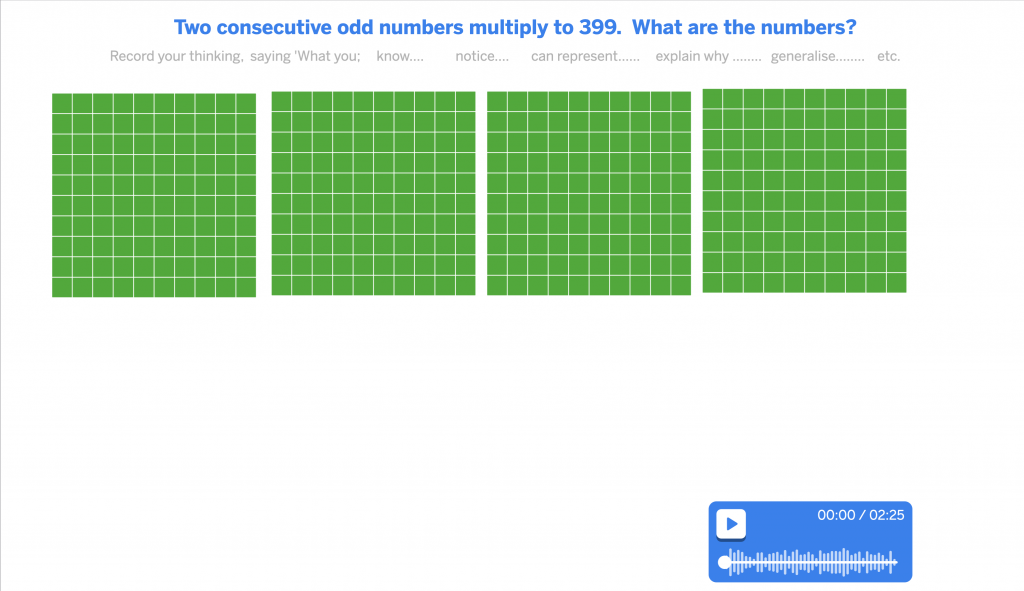
Below is an example reasoning and problem solving task which can be readily amended for children of different ages or prior attainments. The example could be used by a teacher to model to children an approach/thinking.
TASK: Two consecutive odd numbers multiply to 399. What are the numbers?
Teachers should be aware of the limiting factors of PPT animations and their potentially restrictive impacton pedagogy and deep learning in mathematics.
Evidence from my small scale research of PPT based resources currently widely used by schools, showed examples of the number of ‘clicks’ needed in what was identified as an animated PPT slide deck for a single one hour lesson:
Primary – 148 ‘clicks’ in 17 slides
Secondary – 245 ‘clicks’ in 45 slides
Too frequently these PPT animations lead to direct instruction at the expense of developing children’s mathematical behaviours. The slide deck is set up to ‘flow through’ an idea and does not facilitate any live ‘in the moment’ responses to children’s thinking or questions.
Whereas, using dynamic technology there is every opportunity to respond to children with visuals to help them secure the understanding and even offer alternative representations.
Surely we want teachers to be asking children: “What do you notice?” “What do you think will happen when..?” “What number do you want to try next” as well as children being curiousand asking: “What if……”, “Does it always work” Using dynamic technology is about improved pedagogy where teachers are teaching not presenting, the focus is on the needs of the children and how the teacher can meet their needs, and should be included as a key element fin the DfE funded NCETM Big Ideas.!
Below are 2 approaches to the ‘teaching’ of ‘Perimeter of a rectangle’ one from a published resource and one I have created. Each video is less than 2 minutes, and for some readers, today could be the day you are enlightened to the potential of dynamic technology!
The Animated PPT approach
Children are watching a procedure being modelled but the animation does not embed the conceptual understanding of the perimeter being a measurement of length nor encourage children encouraged to develop their mathematical behaviours.
Slide 1 24 separate red lines appear, which may well be used for choral class chanting/counting, but will children be focusing on the sequence of counting numbers or recognising the red lines are meant to be representing a length?
Slide 2 Again the animated red lines are not showing lengths. Children are led to the fact opposite sides of the rectangle have the same value and sum to 24. The algorithm is correct.
Most importantly the children are not seeing the Perimeter as a measurement of length and evidence of its location on the rectangle, and they are only working with one example.
Now for the Dynamic Technology version.
The dynamic technology can be used Front of Class or on 1:1 devices.
As with any learning environment it is the teacher’s pedagogy that makes the difference to learners in classrooms, but with this dynamic technology there are visuals to support children of low prior attainment in their learning.
I would create the first rectangle to simulate the rectangle of tiles and the child stepping around them in the image, then encourage the children’s curiosity by asking children in the classroom: What do you notice? What rectangles shall we draw next? What can you notice now and can you make any generalisations? Does your generalisation always work?
The classroom experience being
You do, the children are invited to action and respond to the task provided We do, the children and the teacher build up/draw together the finding on the mathematical concept I do, the teacher refines the class findings to develop more sophisticated mathematical generalisations.
Using dynamic technology children can:-
learn from feedback
readily compare and contrast different representations
pattern spot – explore the effects of varying values and look for invariance and covariance
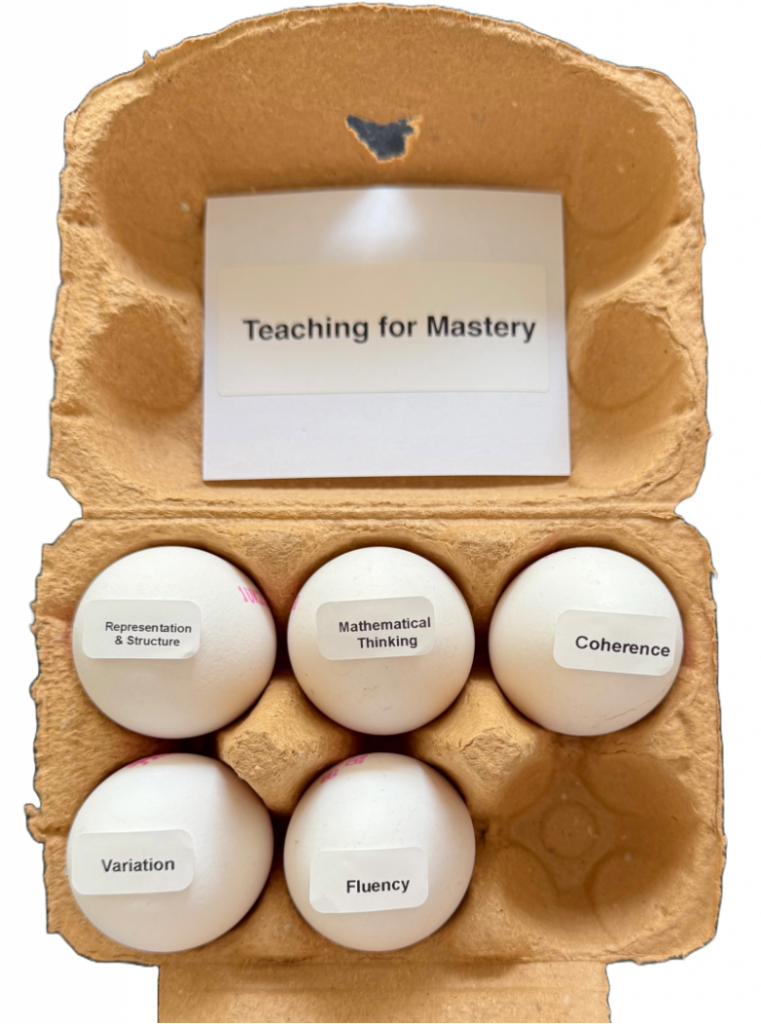
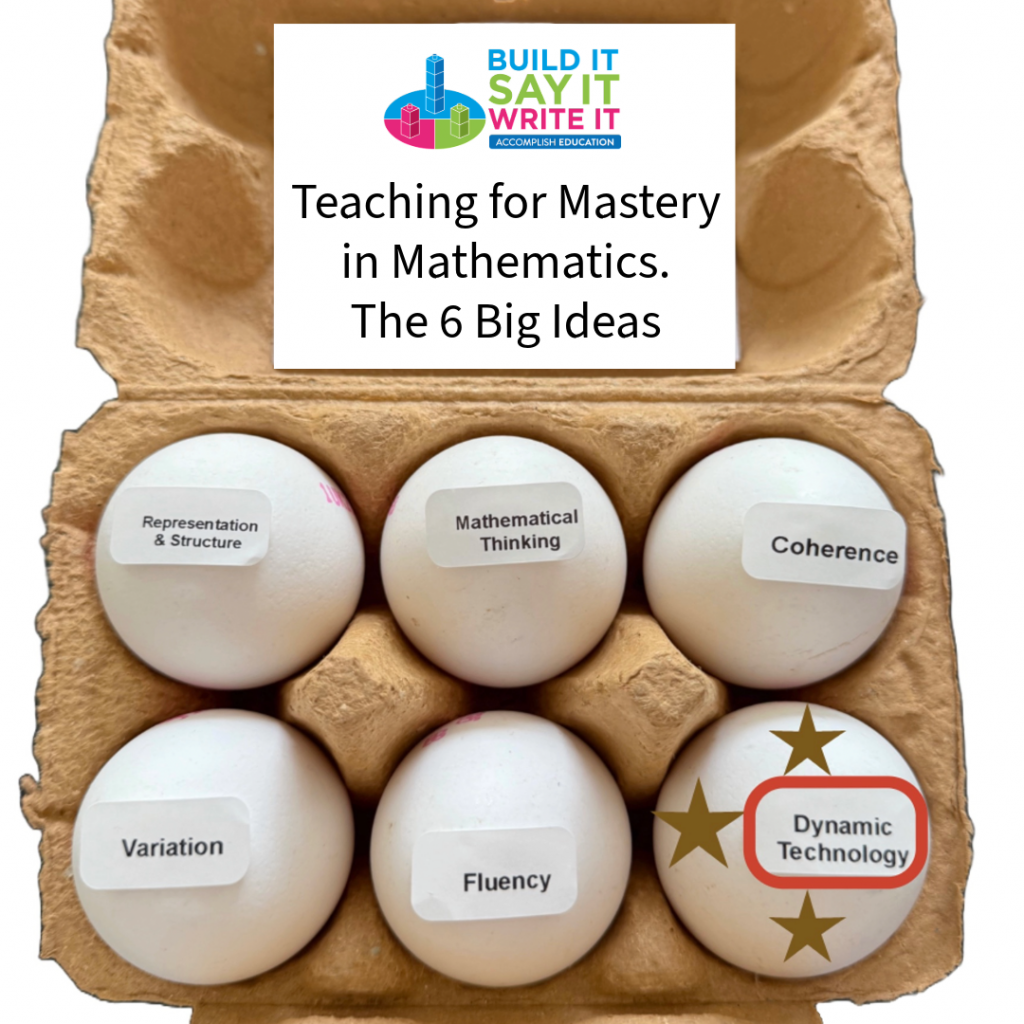
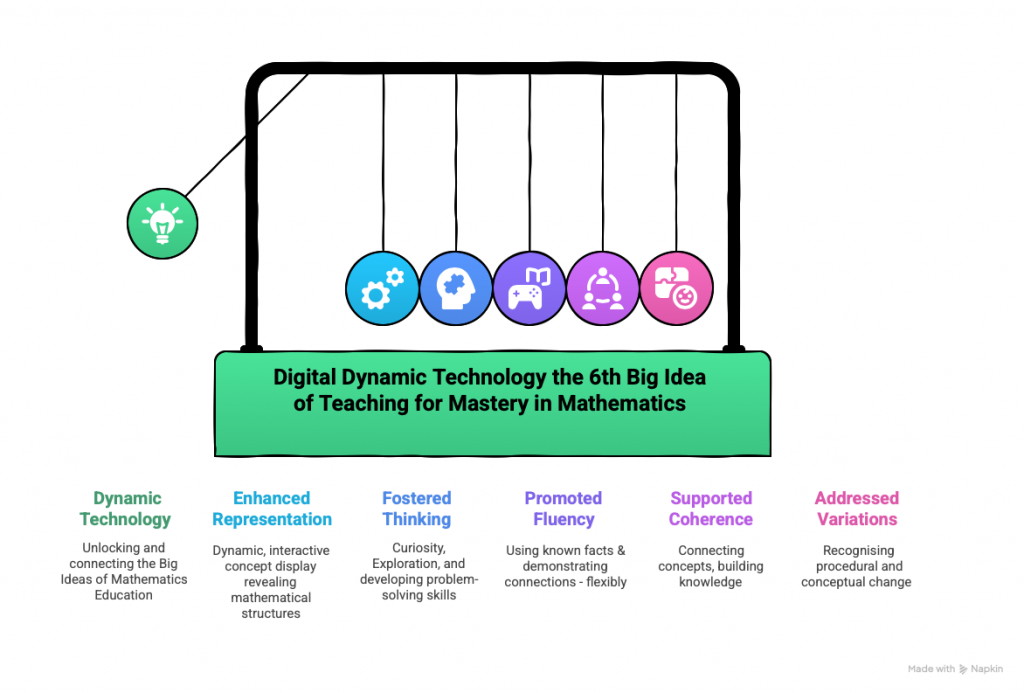
The DfE funded NCETM has 5 Big Ideas at the core of Teaching for Mastery (TfM) in Mathematics for all UK schools. For a 21st Century Mathematics education the place of Digital Dynamic Technology must surely be included and become the 6th Big Idea in TfM.
The JMC report of 2011 highlighted this missing element and in 2023 said little had changed. In 2025 there is still an absence of dynamic technology being promoted.
The current practice of using PPT with single use animation does not offer anything like the potential of dynamic technology, results in children ‘watching’ and not being given the opportunity to see ‘in the moment’ visual responses to questions they ask. The integration of dynamic tools and interactive learning experience creates a more engaging and personalised learning environment for all children to develop the essential Mathematical Behaviours.
Recent evidence from Nottingham University Observatory for mathematical education offers further support with a key finding from the ‘Key Stage 3 teachers of Mathematics Themed report 25/01’ (April 2025):
“The most pressing professional development need reported by KS3 maths teachers is on the use of digital technologies.“
Direct evidence from teachers collated from conference presentations I have delivered and numerous CPD sessions I have led for both Primary and Secondary teachers support my recommendation for Dynamic Technology as the 6th Big Idea for Teaching for Mastery, e.g.:-
“Digital technology in maths is such a powerful learning tool for all learners – our focus on adaptive teaching will need to consider this if we want to truly to ensure all children are included in the lesson.“
“The slide on ppt clicks was incredible and made me reflect on how the children in my class learn – are they really interacting with the maths??“
“Love the teaching ideas, schools need more guidance on this”
“Love the interactive tangible nature of your presentation – you showed what is possible in context!”
Evidence from the neuroscientists adds further support for the use of Dynamic Technology can offer to the learner:
‘Advocates of dual coding theory argue that people retain information best when it is encoded in both visual and verbal codes’ (Byrnes, 2001, p. 51). It is therefore appropriate to surmise that using visualisations improves retention of the mathematics taught.
Schacter’s (2001) research implies that students may ignore symbolic work, if not accompanied by visualisations.
Additionally ‘Any attempt to reduce transience (memory loss over time) should try to seize control of what happens in the early moments of memory formation, when encoding processes powerfully influence the fate of the new memory’ (Schacter 2001)
When a child has a personal stake in the task, he can reason about that issue at a higher level than other issues where there isn’t the personal stake… These emotional stakes enable us all to understand certain concepts more quickly. Greenspan and Shanker (2004)
IMO – Teaching for Mastery must include Dynamic Technology
The use of dynamic technology positively impacts on and connects the other 5 Big Ideas.
It is important to explicitly value the visualising and thinking children engage in and not just focus on the correct final answers.
Far too often children jump into performing a calculation without appreciating the full task or problem and the ‘components’ actually needed.
Gestures and talk are likely to be early demonstrations of children’s visualisation, and this is best achieved by delaying access to recording materials, giving children the opportunity to interact before ‘diving into’ a pool of mathematics.
Children need to have enough time to secure an understanding of the problem and a strategy before they start. It is the need to get ‘a feel’ for the task which I describe as the ‘Build-it’ stage; build a mental image or physically build a representation with manipulatives which enhance the understanding of the problem and helps children consider:
what they do know
what they need to know
what they have enough information to ‘work out’?
what information they need to work towards their solution
what are the options if they don’t have the mathematical knowledge
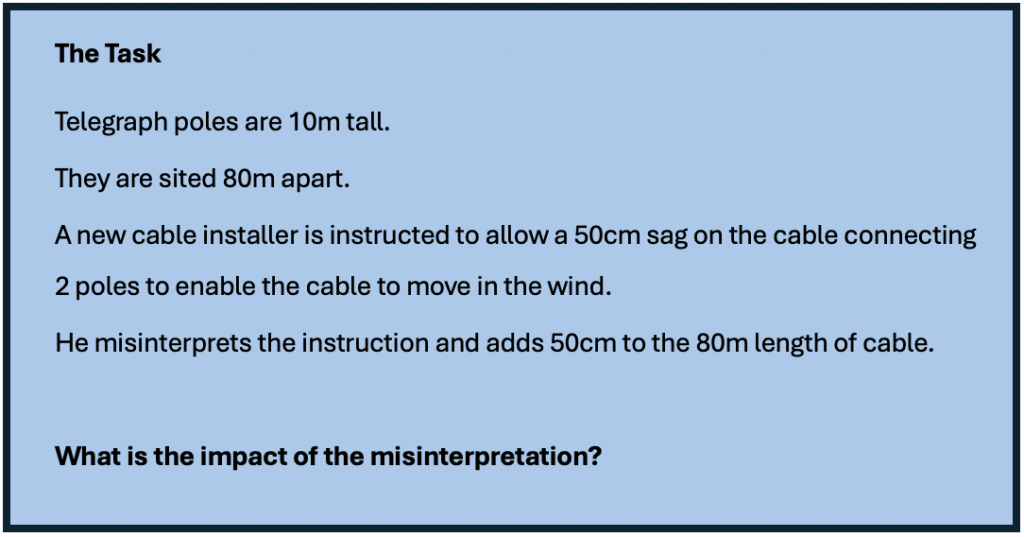
To demonstrate this approach I gave the task below to a mixed group of secondary school mathematics and science teachers for whom GCSE Mathematics was the common qualification attained but for some it was ‘a quite a while ago’!
Teachers started by using their forearms to indicate the vertical telegraph poles and gesturing/ ‘air drawing’ whilst talking about a cable between the posts – “a straight line between the poles will be 80m and the cable should sag below the horizontal”
Already the shared language is key to supporting visualisation:
straight
vertical
horizontal
sag
Teachers talked of their mental picture of telegraph poles and to appreciating a distance of 80m related to a more commonly recognised distance of 100m track length. When it came to the gesturing the intended sag, the distance between the ends of fingers when pinching the first finger and thumb was an attempt to visualise the ‘smallness’ of 50cm length relative to their poles 80m apart.
Part 2 – using AI
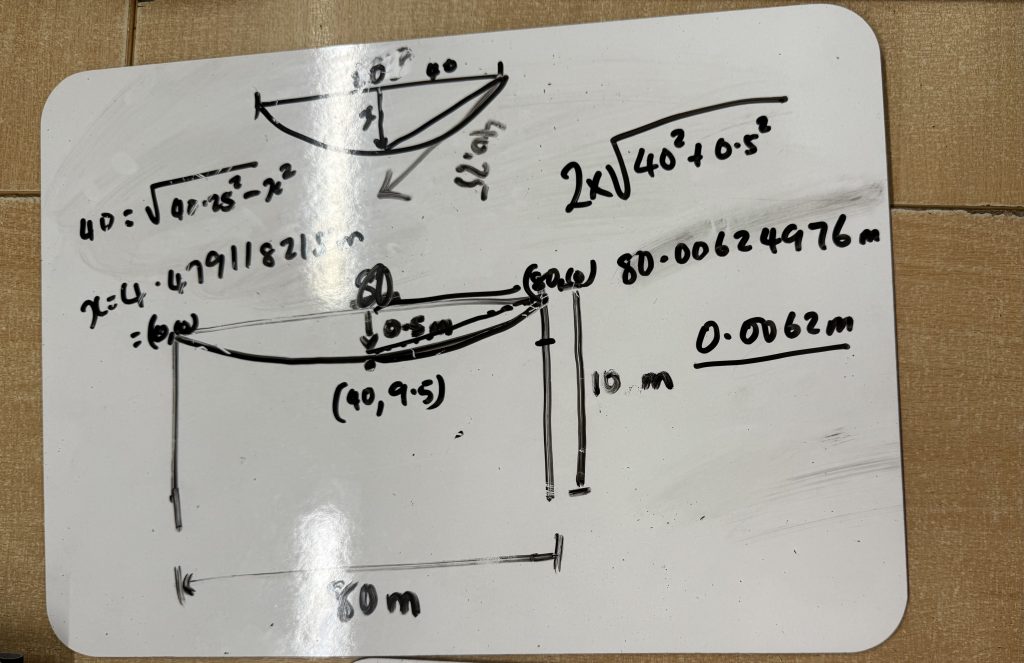
It was at this point the teachers sketched on A3 White Boards (an ideal size for collaborative working) a representation of their visualisations and discussions so far; shared gestures, language and reasoning with explanations of:
midpoint
parabola
symmetrical
approximating lengths to line segments and calculate using Pythagoras Theorem
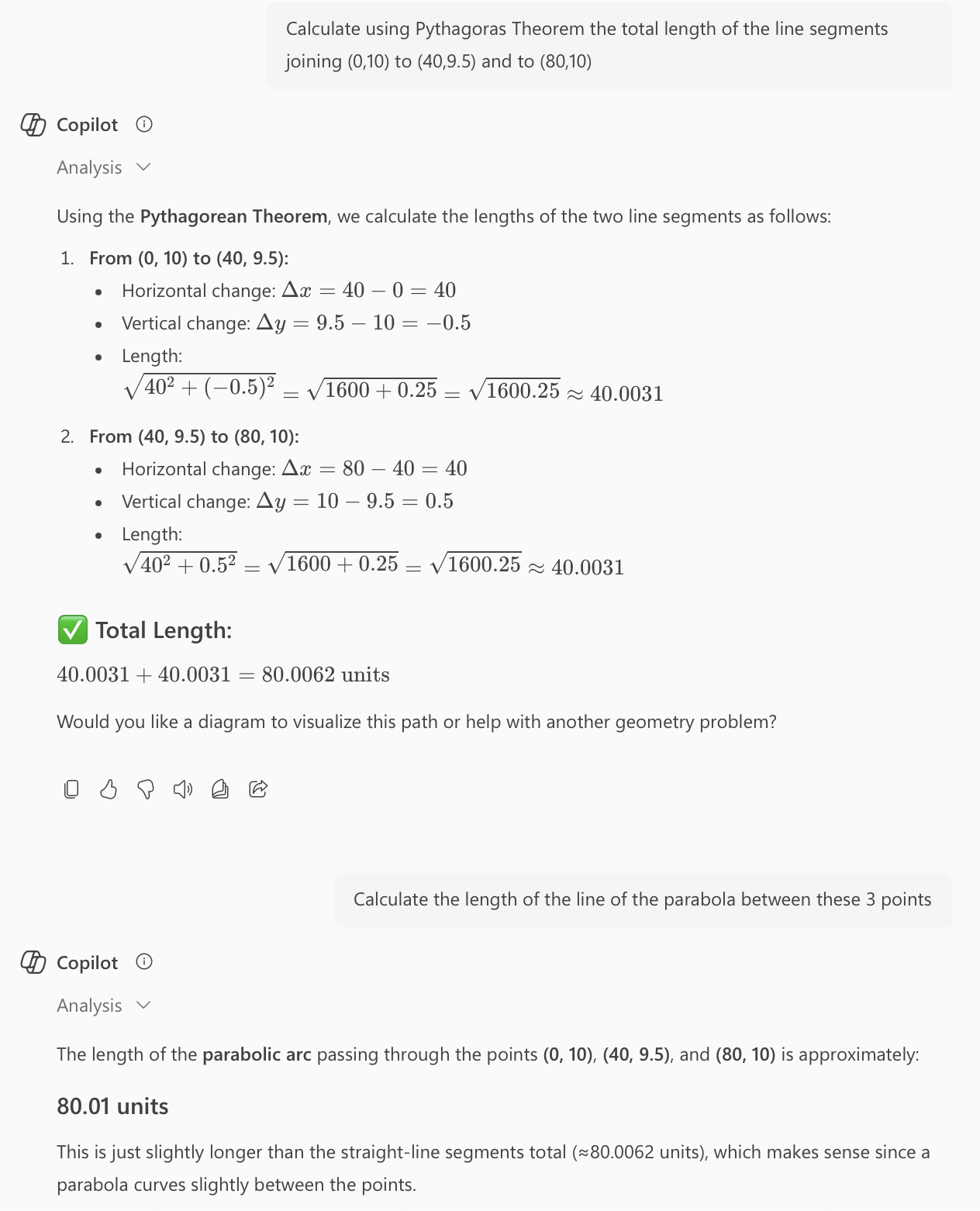
With the information available the mathematics gets more challenging (beyond GCSE) if you want to calculate the exact length of the cable forming an arc of a parabola, and this is where AI can assist. However, AI needs to be asked clear questions!
Let’s ask for the intended cable with a 50cm sag
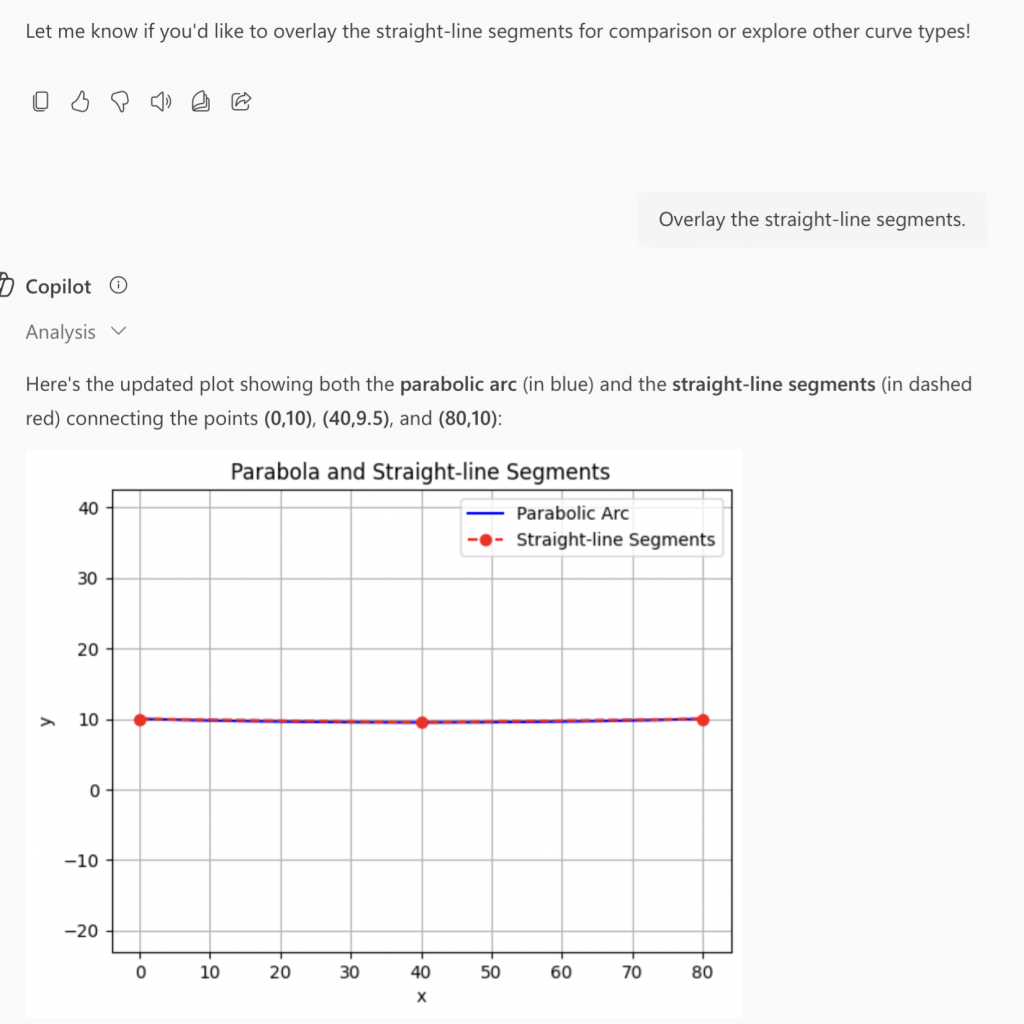
What is the approximated length of the cable using the length of the line segments and Pythagoras Theorem – checking our calculation?
What is the calculated length of the parabola passing through the 3 identified points?
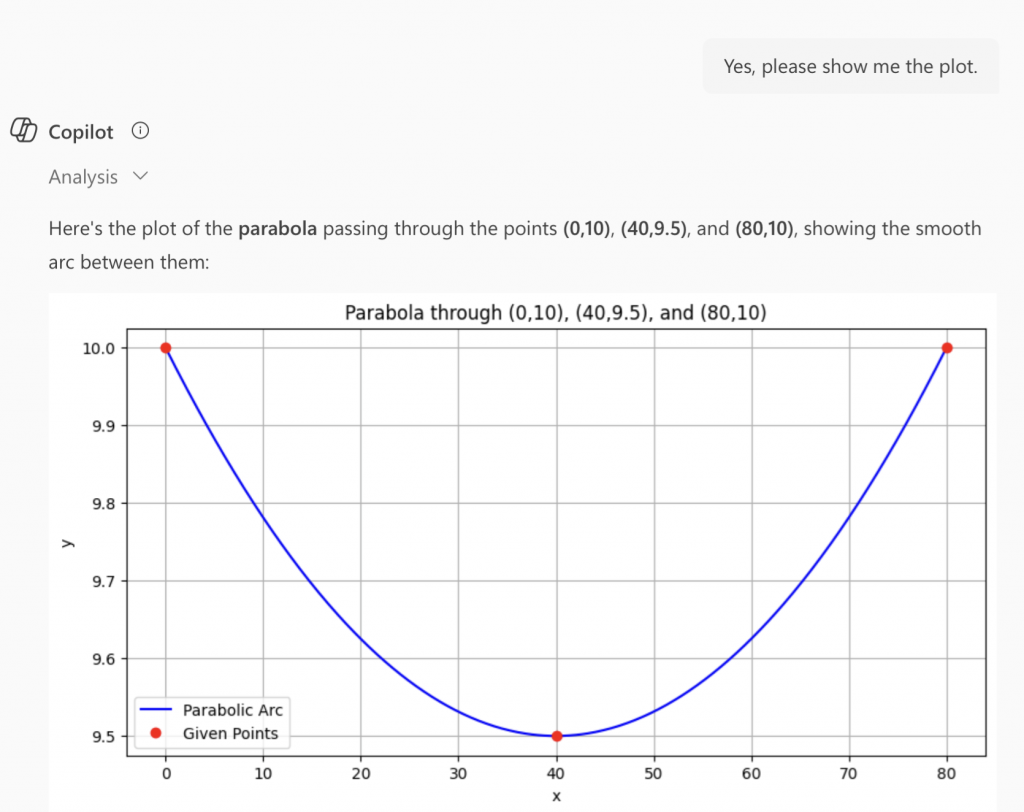
What does a graphical representation of the curve look like ( checking our sketches)?
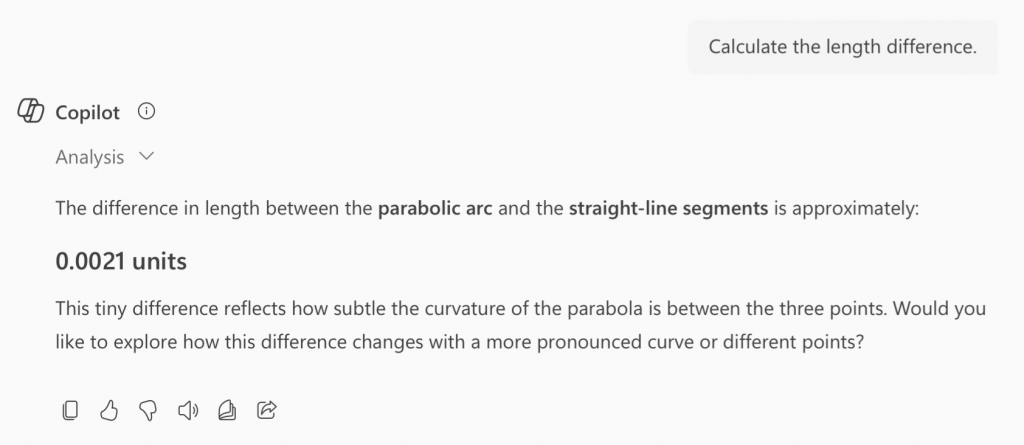
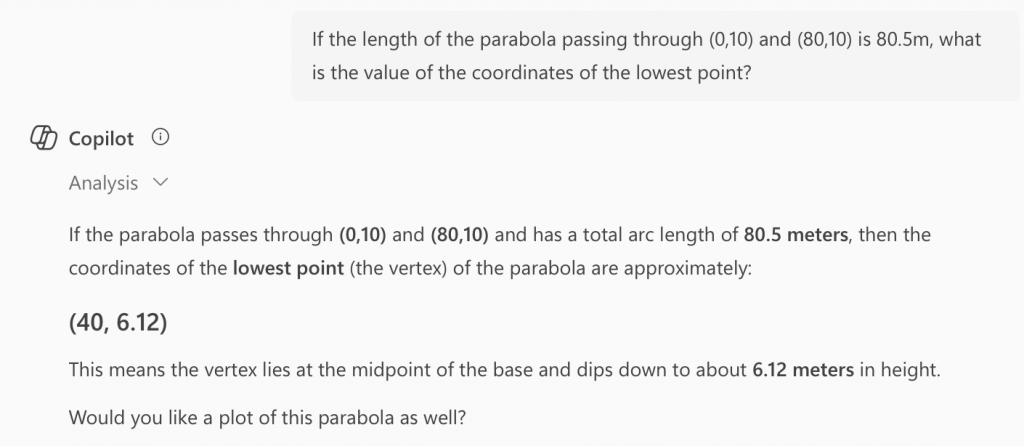
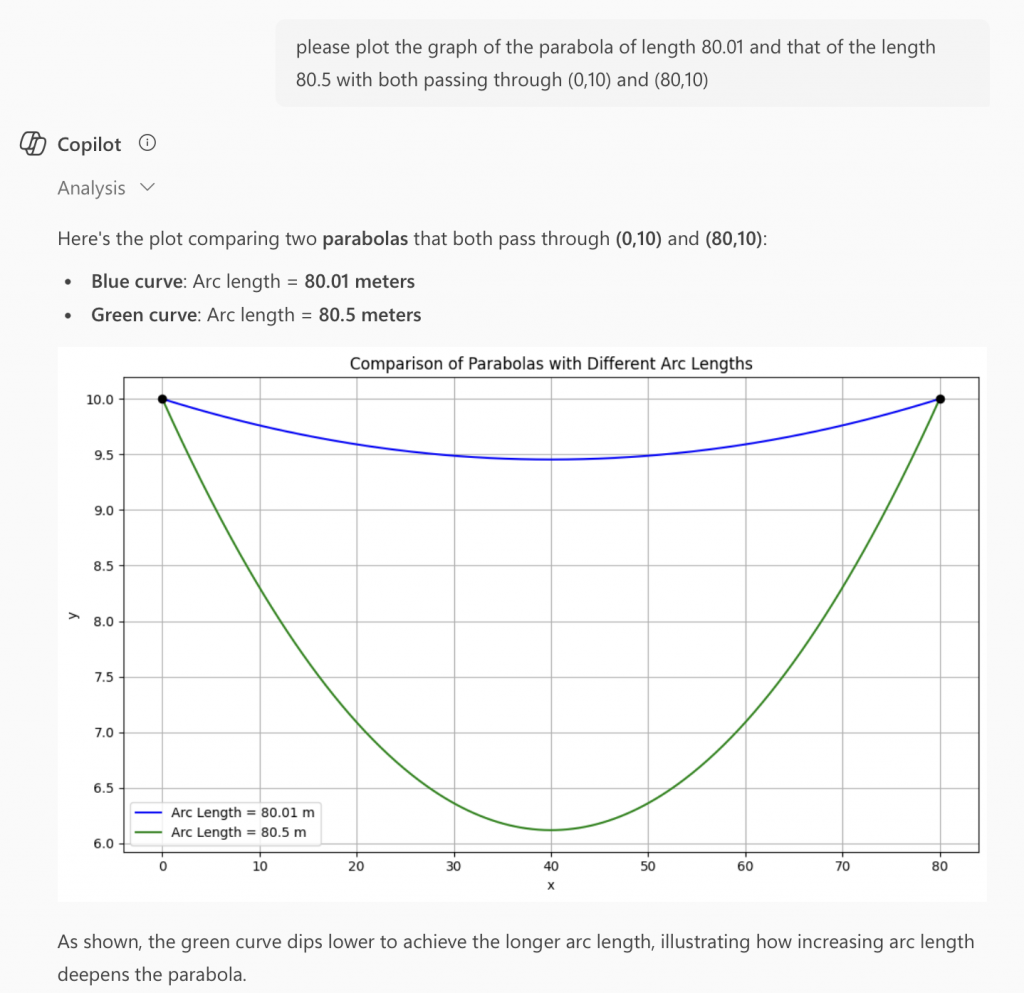
The following includes our questions to Co-Pilot and the AI responses.
Now let’s ask about the ‘mistaken’ cable which has a length of 80.5m
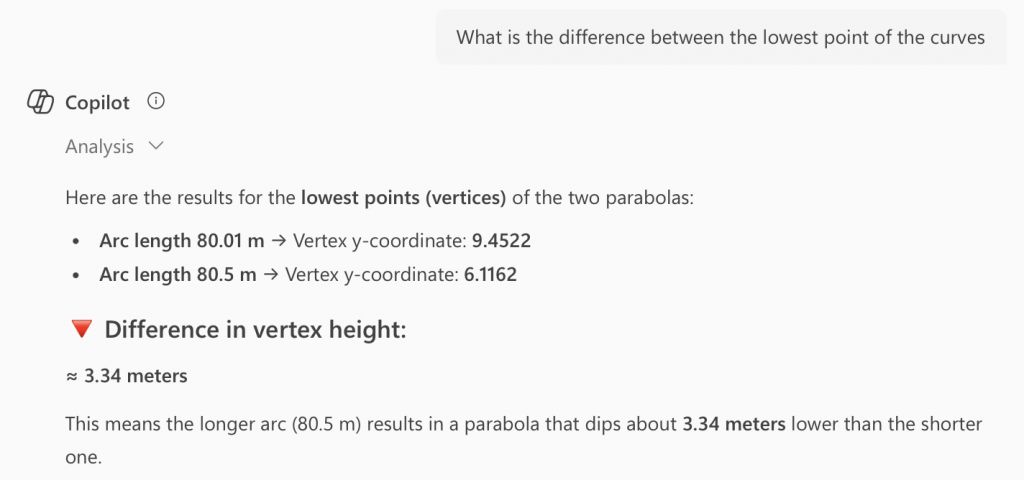
What is the lowest point of the parabola passing through (0,10) and (80,10)?
What is the difference between the ‘intended’ sag of the cable and the ‘mistaken’ sag?
For AI to be useful, students (and teachers) need to
follow a logical argument
Identify and communicate the requirement of the task – can they describe what they want to build, in detail and guide the process?
be curious, collaborative and resourceful
‘guesstimate’, reflect and check reasonableness/accuracy of AI responses
SupportingMetacognition
Visualisation, gestures, collaboration and articulating their ideas help children develop the skills needed for problem solving:
“comparing different students’ approaches to problem solving and decision making; identifying what is known, what needs to be known, and how to produce that knowledge; or having students think aloud while solving problems” (Costa, 1991)
The school as a home for the mind: A collection of articles. Corwin. [Google Scholar]
• Modelling your thinking out loud helps pupils develop their own strategies
• Resilience is built by teaching children strategies for what to do when they do not know what to do.
• Identifying appropriate questions to ask in AI can support children as they work towards a solution
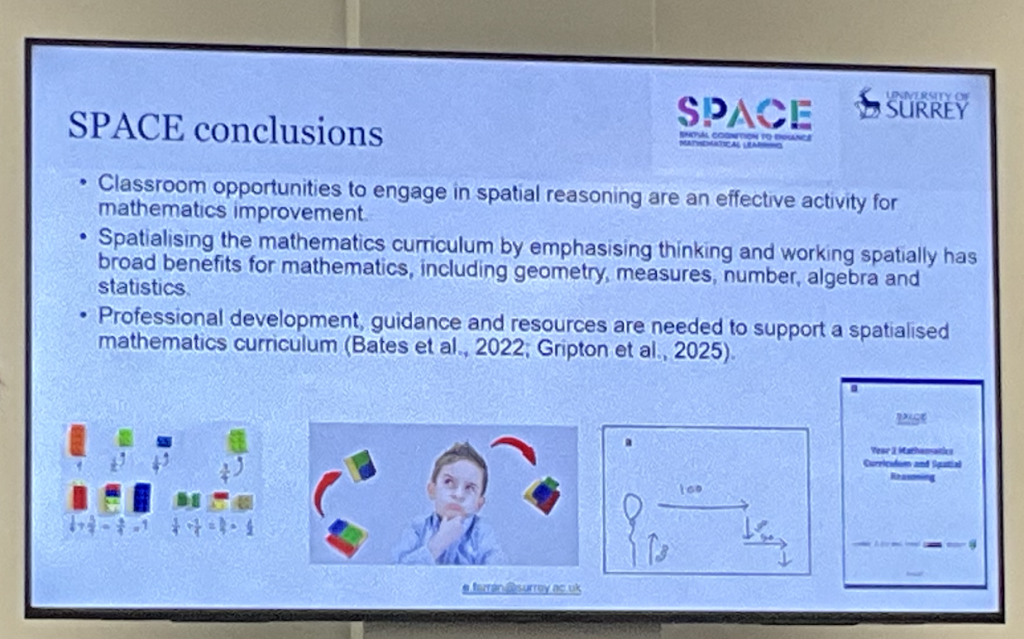
Privileged to have been invited to ‘Make Space – the value of spatial reasoning for Mathematics’ event led by Emily Farran at Surrey University this week.
Some key reflections: 1. Spatial abilities can be trained and increases achievement in mathematics 2. Spatial reasoning is intrinsic to learning in all domains of mathematics 3. Spatial reasoning leads to flexible thinkers 4. Mental maths questions should be include spacial reasoning. 5. Spatial reasoning is for EYFS to adult 6. Spatial reasoning should not be ‘bolt on’ to the curriculum 7. The use of technology for spatial reasoning is currently underdeveloped in UK
CPD will be key to making an awareness of the importance of spatial reasoning and developing strategies with teachers to use in the classroom.
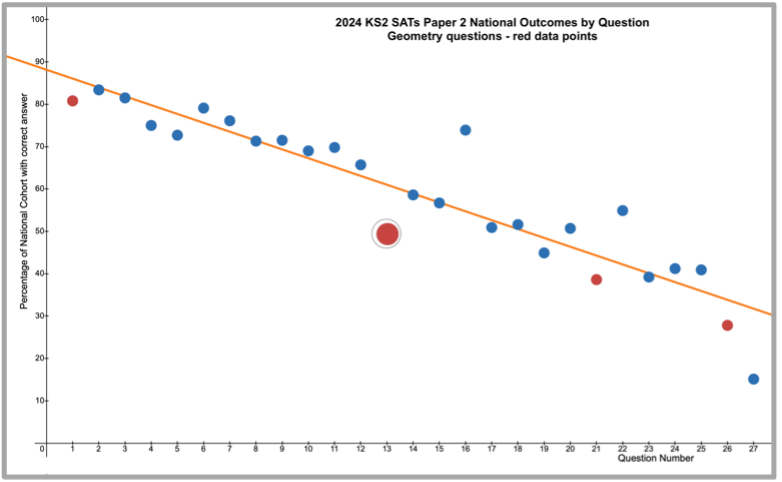
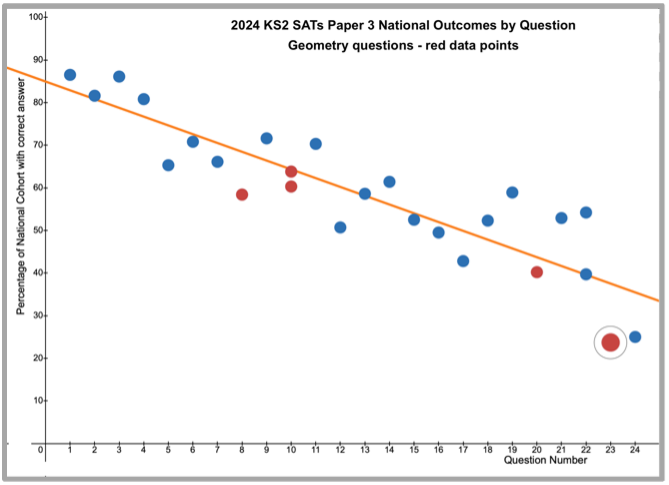
When reviewing the data of the national KS2 SATs 2024 outcomes by question, the eye is always drawn to the pieces of data that ‘buck the trend’. I am not aware that the data is expected to rigidly align with a statistical ‘line of best fit’ but is used here as a tool to assist when reviewing.
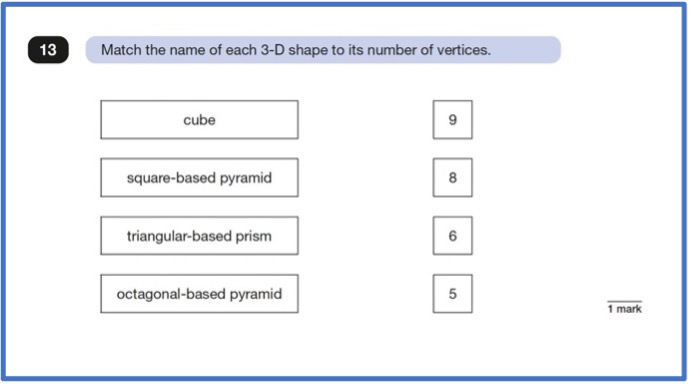
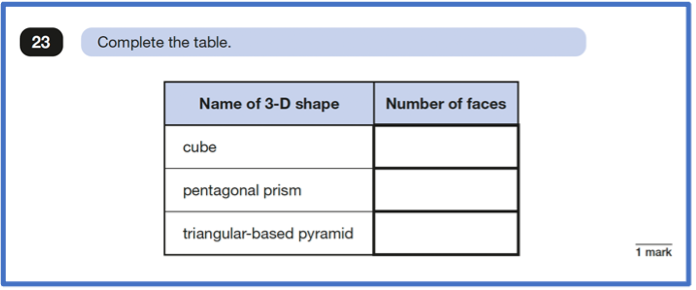
My attention was drawn to Question 13 on Paper 2, a mid-paper question and <50% of the cohort submitted a correct answer, approximately 11% less than might be anticipated using the ‘trend line’ of the graph below. Question 13 is on the topic of 3-D shape as is Question 23 on Paper 3, which received 23% of the cohort answering correctly, the lowest percentage and furthest below the trend line for any question on the paper.
Whilst the circled red data points are questions focusing on 3-D shape only, it is worth noting all Geometry questions on Paper 2 (Qu’s 1,13, 21 and 26) and on Paper 3 (Qu’s 8, 10 ,20 and 23) fall below the ‘line of best fit’ in the graphs!
These are the 3-D Shape 2024 SATs questions:
Paper 2 – ReasoningPaper 3 – Reasoning
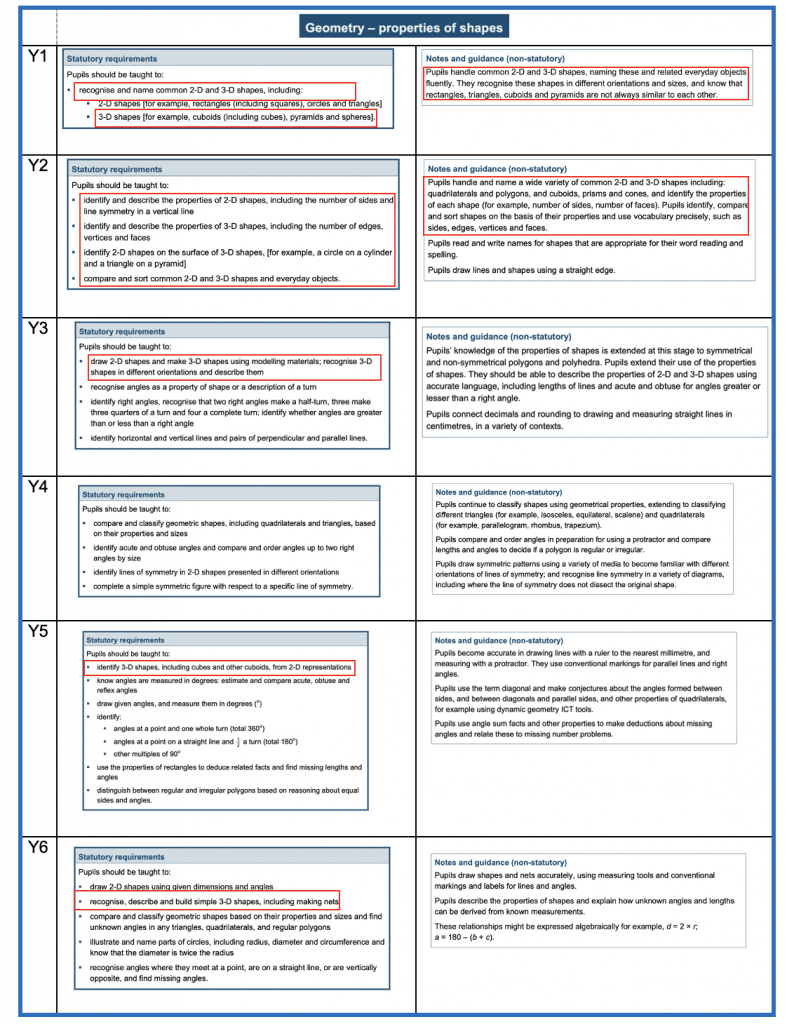
These two 3-D Shape questions primarily relate to National Curriculum content from Years 1-3 of the Programmes of Study for Mathematics (2013) with the KS2 expectation for children to recall mathematical subject knowledge and reason using the knowledge.
A key requirement for children to answer these questions would be to have a visual recall or mental image of the shapes. Based on the outcomes detailed above, it would suggest a significant proportion of children do not have a working command of this knowledge/skill. Insecure foundations are likely to impact on children when working at KS3/KS4.
The following offers support for teachers as to how this issue may be addressed:
Children need to be provided with the opportunity to develop a visual mental recall of 3-D Shapes
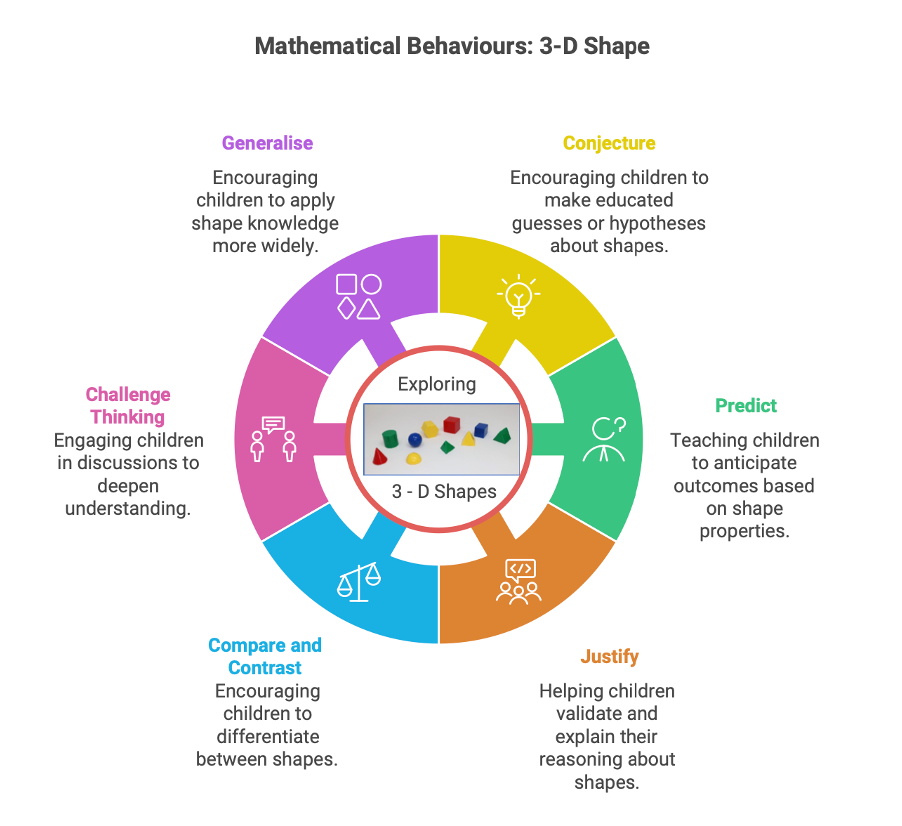
The need for children to ‘play’ and ‘explore’ when learning mathematics is not something to be restricted to EYFS and KS1. Play allows children to observe, make sense of and provide a concrete example to help communicate their thinking and understanding. Play is an essential part of children having the opportunity to develop the desirable mathematical behaviours of young mathematicians:
to conjecture
to predict
to justify
to compare and contrast
to challenge another’s thinking through asking questions and discussion
to generalise
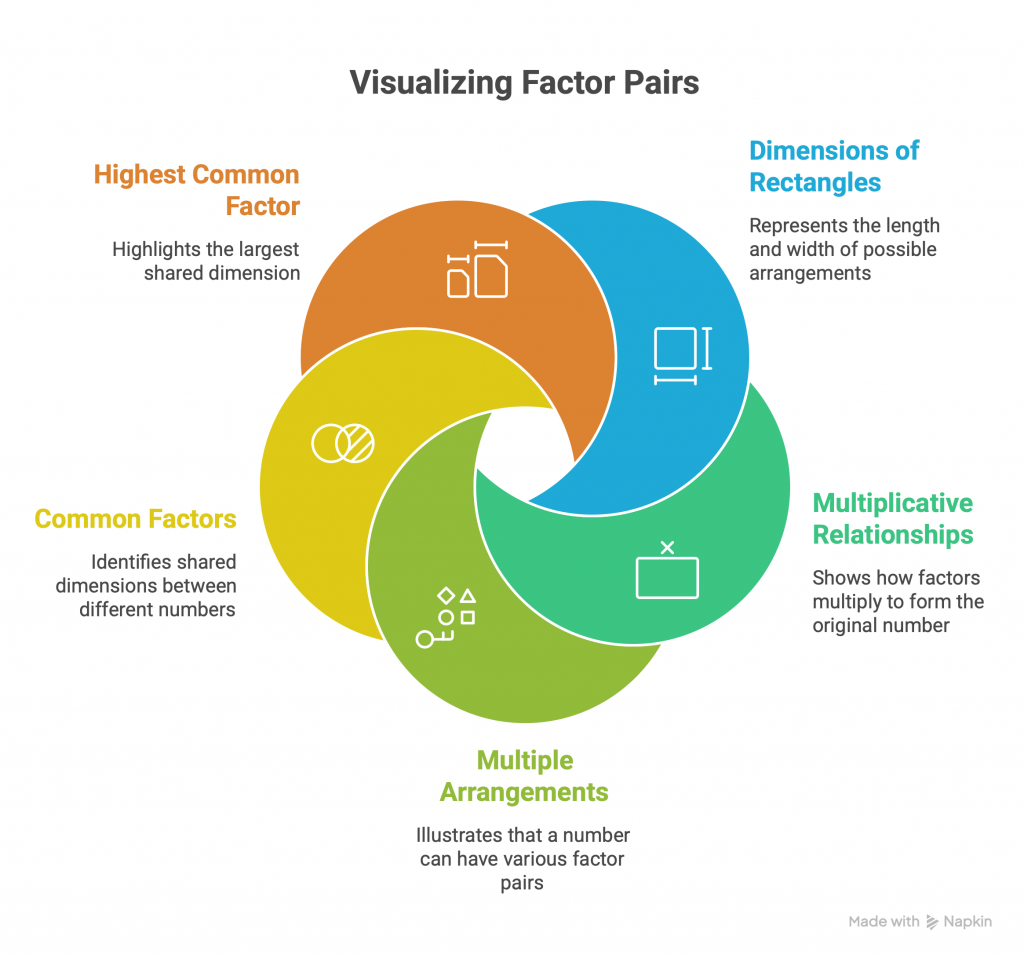
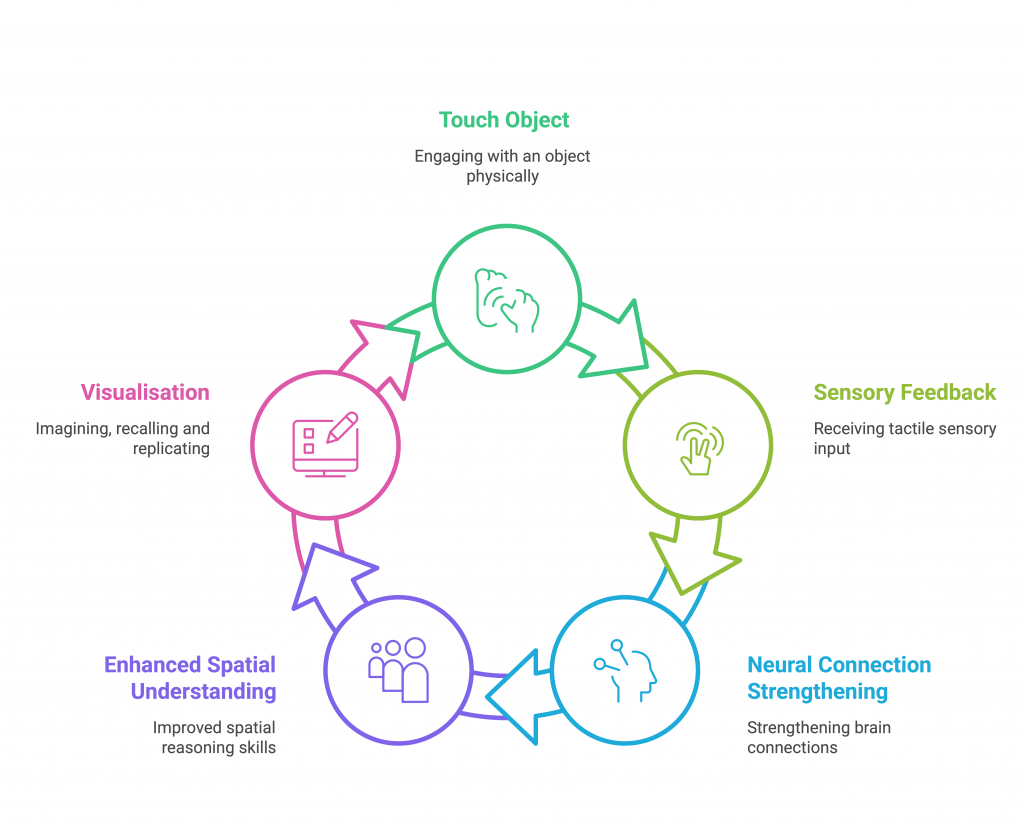
Design created using Napkin.ai
When children have a mental image/visual recall of 3-D shapes they are not reliant on separate memorised facts. The visualisation empowers the child to identify multiple facts, answer questions and reason solutions to problems.
“Talk in mathematics should not be seen simply as a rehearsal in class of the vocabulary of mathematics… It should extend to high-quality discussion that develops children’s logic, reasoning and deduction skills, and underpins all mathematical learning activity. The ultimate goal is to develop mathematical understanding – comprehension of mathematical ideas and applications.” The Williams Report (2008)
The Role of the teacher is to:
provide learning opportunities/tasks for the children’s mathematical habits to be developed
probe children’s thinking with appropriate questions
introduce and refine mathematical language whilst allowing children to talk freely in a non-scripted manner
3-D Manipulatives
Provide the children with a suitable range of 3-D shapes to touch and hold, connect and separate, compare and sort.
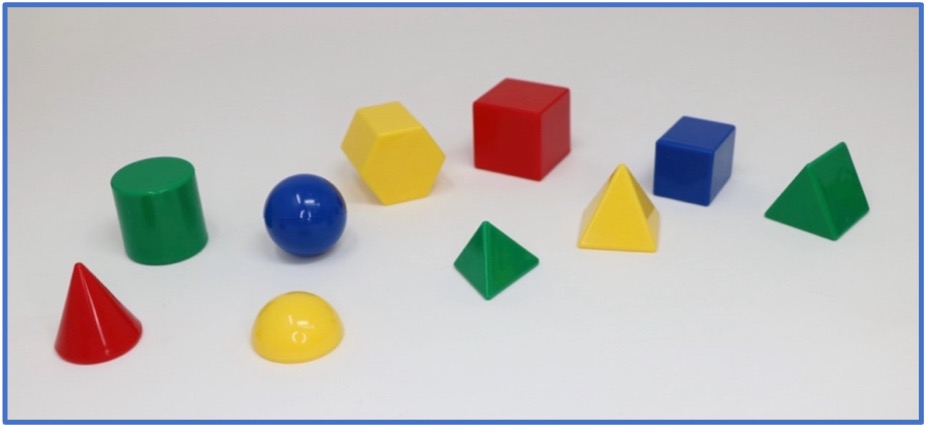
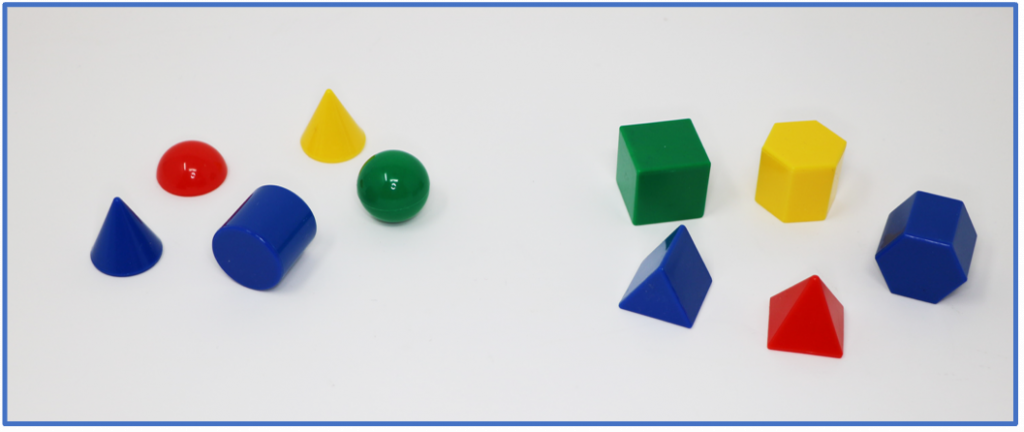
E.g. A set of ten different 3-D shapes; cube, triangular prism, rectangular prism, hexagonal prism, triangular pyramid, square pyramid, sphere, hemisphere, cone and cylinder, each in 4 different colours provide opportunities for children to explore the content required for primary school learning. Note this set unlike many others includes a hexagonal prism encouraging children to think about 3-D shapes with polygons of more than 4 sides.
Source TTS MA03349
Tasks
The following tasks are intended for children to do in pairs or small groups. Each task can be adapted for the age and/or prior knowledge of the children when selecting the 3D shapes to be used. The purpose of the tasks is:-
to encourage children to talk/discuss as they touch and play with the 3-D shapes
to gather an insight into the key features of the shapes
to support the development of visualising shapes – which is hard to achieve from looking at only diagrams
1.Feely bag
This task is for children to develop and use their sensory and oracy skills to describe 3-D shapes.
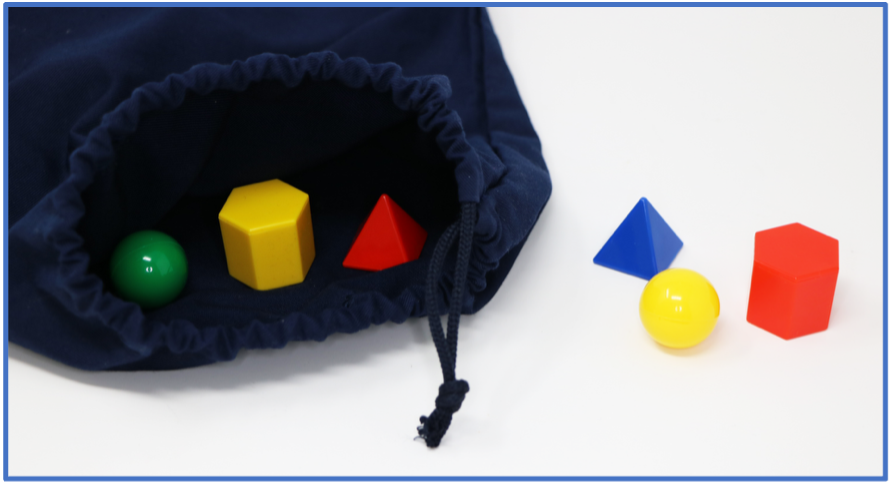
A selection of 3-D shapes is placed in a non-transparent bag.
One child puts their hand in the bag, selects one shape without removing the shape from the bag or looking inside.
Using touch alone, the child must describe the selected shape to their partner/s, one detail at a time
Partner/s suggest the identity of the shape either by naming it or pointing to what they think is the shape from a separate set of shapes
Once children think they have identified the shape, it can be removed from the bag to check.
Repeat the task with another child making the shape selection
3-D shapes and Opaque Feely Bag
Questions:
What vocabulary/descriptions are most helpful?
How many pieces of information do the children need to identify the shape correctly?
2.Sorting
This task is to help children to identify and categorise the key features of the 3-D shapes
A selection of 3-D shapes is placed on a large piece of card.
Working in pairs/small group children sort the physical shapes into 2 groups, agreeing the sort criteria.
Allow children to describe the criteria using their own description which can be refined to mathematical language.
e.g. Shapes with a ‘Rounded surface’ (curved surface) and shapes without.
Shapes sorted into 2 groups
Questions:
How do you decide which group a shape is to be placed (sorting criteria)?
How can you sort the same selection of shapes in a different way?
How are your sorted groups of shapes the same or different to another pair/groups? What criteria have they used to sort the shapes?
The task could be repeated using shapes with some common elements (Venn Diagram), or shapes sorted into 3 separate groups or 2 dimensional shapes could be included.
3.What’s my shape?
This task is to encourage children to ask questions and in doing so develop, refine and practice their skills in precision of questioning and use of mathematical language.
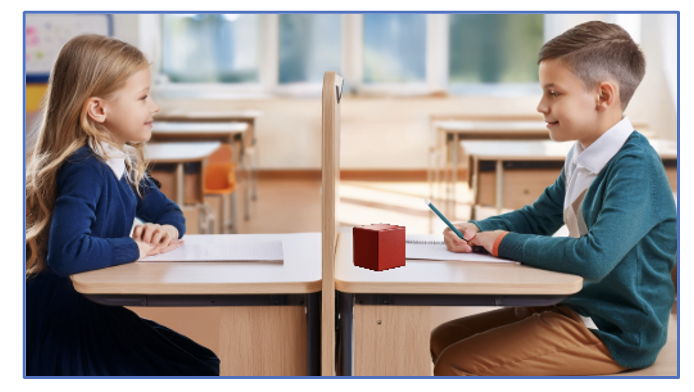
Two children face each other with a white board or similar acting as a barrier between them and ensuring neither can see what is on the opposite side. Alternatively, children could sit back to back.
A child selects a 3-D shape and hides it from their partner behind the barrier.
The partner must ask questions to identify the hidden shape.
Initially allow questions to be open, however as the task is repeated it can be more challenging if the child with the shape can only respond with Yes or No to questions.
Image generated with Adobe Express
Questions:
What questions could the partner ask the child to help them identify the shape? E.g.
Are all the faces the same shape?
How many faces does the shape have?
Does it have a ‘pointy’ end?
What refinements can be made to a question/answer? (supported by the teacher) e.g.
“What is the mathematical term for a ‘corner’?”
Is the end at the top or the bottom – does it matter, is the orientation important?
Are some questions more helpful/informative than others? – make a list of ‘good’ questions
4. WODB – Which one doesn’t belong
This task is for children to practice and strengthen their visualising skills, critical and creative thinking with reasoning.
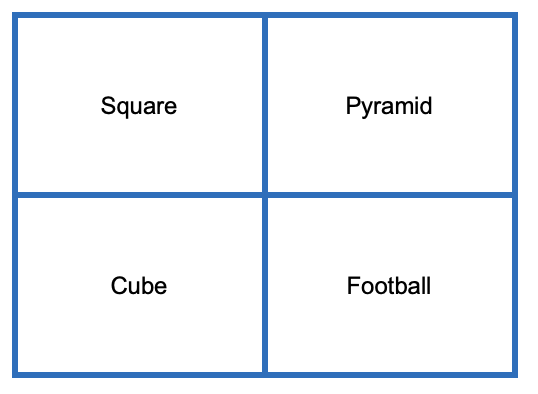
The names of different 3-D shapes/objects are placed on the 4 sections of the card.
Children will need to visualise the four shapes/objects and use their knowledge of the shapes to reason which they consider to be the ‘odd one out’ based on the attributes of the shapes.
The choice of shapes/objects should not lead to there being only one correct answer.
Encourage children to think creatively when looking for attributes
A collection of cards can be made for future use and could include landmarks etc which link with a recent humanities topic.
E.g. WODB – with possible reasons for selection
WODB Example Card
Football because
it is made up of hexagons and pentagons
it has a curved surface
Square because
it is 2-D
it has 4 sides (not edges)
Cube because
all faces are equal in area
a regular polyhedron (3-D shape)
Pyramid because
it has triangular faces
it has a point (apex) when its base is on the table
Questions
Do all pyramids have the same shape base?
Are all footballs made from Hexagons and Pentagons?
What’s the difference between a pyramid and a prism?
Which 3-D shapes always have the same shape face at either end?
What other shapes have an apex?
National Curriculum Statements DFE Reference 00180-2013
Pip Huyton is a mathematics consultant working in both the primary and secondary sectors. Her roles involve being a trainer, adviser, facilitator, often in a bespoke school improvement capacity. Interests include curriculum development, the use of manipulatives for supporting children developing conceptual understanding and effective use of dynamic technology for learning.
Authored:
Build-it Say-it Write-it Understanding the concepts of Perimeter and Area using Manipulatives
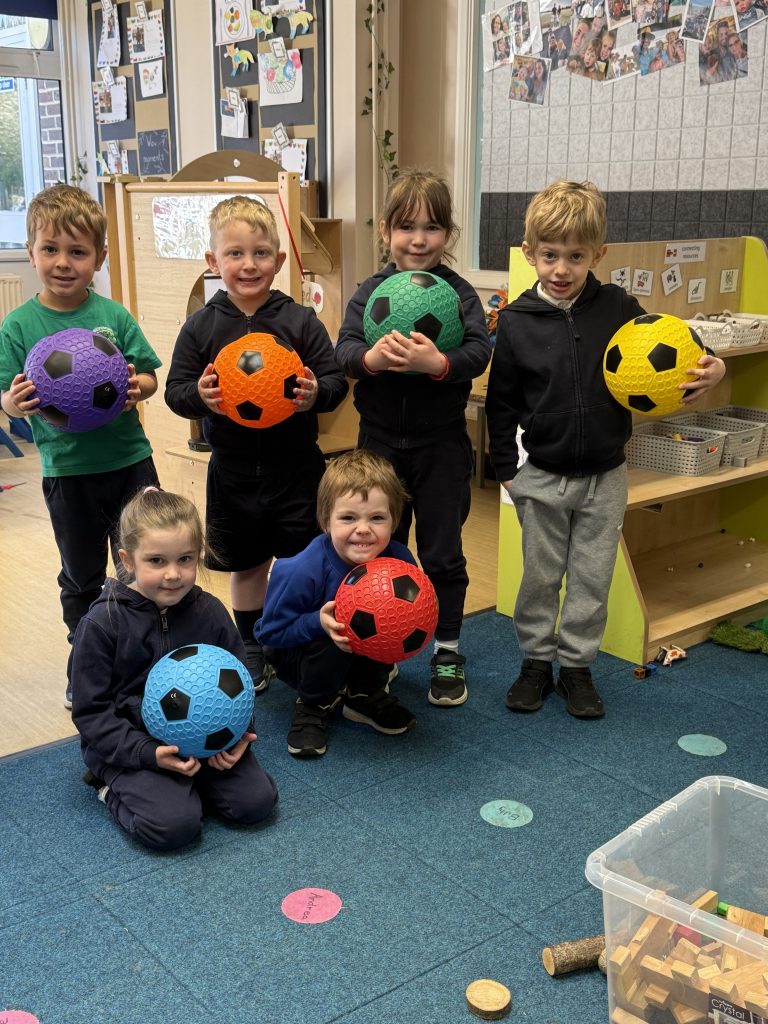
Curiosity is the one of the most important attributes that you can want for a child. Today was an example of where young children in reception were curious to ‘play’ with the resources I brought with me – footballs from TTS . Yes the first interest of some children was to take the football outside and kick the ball, but whilst standing for the photograph curiosity ‘kicked in’ just looking at the football they held and prompted them to explore and ask questions.
How many black ‘spots’ are there on the ball?
What shape are the black marks on the ball, as they ran a finger along the outline of the shape?
Their questions were developed by the class teacher and the children learnt a new word Pentagon. Memorable moments which can be developed further to recognising the shape in other circumstances, defining other shapes starting from the football – a Hexagon, Sphere. All part of their learning of Geometry and Spacial reasoning.